Key Takeaways
- A record El Niño could bring drought to Central America and the Panama Canal and floods to Peru, Ecuador and southern Brazil.
- Weaker governance makes Nicaragua, Honduras, Guatemala, Venezuela and Bolivia most vulnerable, while Colombia, Brazil, Chile and Uruguay are expected to be more resilient.
- Businesses should map exposure by sub-region, and plan for both shipping and price shocks.
Latin America is facing growing risks of supply chain disruption, commodity production losses and infrastructure stress as a super-strength El Niño intensifies into 2027. For large multinationals, the stakes are high: the region underpins global supplies of copper, coffee, soy, maize and salmon, and hosts critical logistics arteries like the Panama Canal. Disruption here can quickly ripple through procurement costs, production schedules and delivery timelines worldwide. Governments, businesses and investors alike face a major test, as the resilience of logistics, fisheries and agricultural exports, mining operations and energy systems will be severely challenged.
According to our data, a repeat, or even an amplification of the devastating 1997/98 El Niño is possible, which triggered an estimated USD5.7 trillion in global economic losses – almost three times the decline in global GDP during the 2008 financial crisis. This year’s El Niño is already the strongest ever recorded in terms of Pacific Ocean temperatures and is not set to peak until December.
Our Hazard Vulnerability Index (HVI), which assesses factors such as annual economic loss from natural hazards, natural capital, economic fragility, quality of infrastructure, government effectiveness and the sensitivity of populations, shows the impacts will be unevenly distributed across the region.
While drought threatens Panama Canal traffic, agricultural production, and water security across Central America and parts of northern South America, flooding risks are rising in economically critical regions of Peru, Ecuador and Brazil. These diverging climate impacts are set to create operational challenges across major export sectors, from Central American coffee and maize to Peruvian anchovy and copper, Chilean salmon and Southern Cone soybeans.
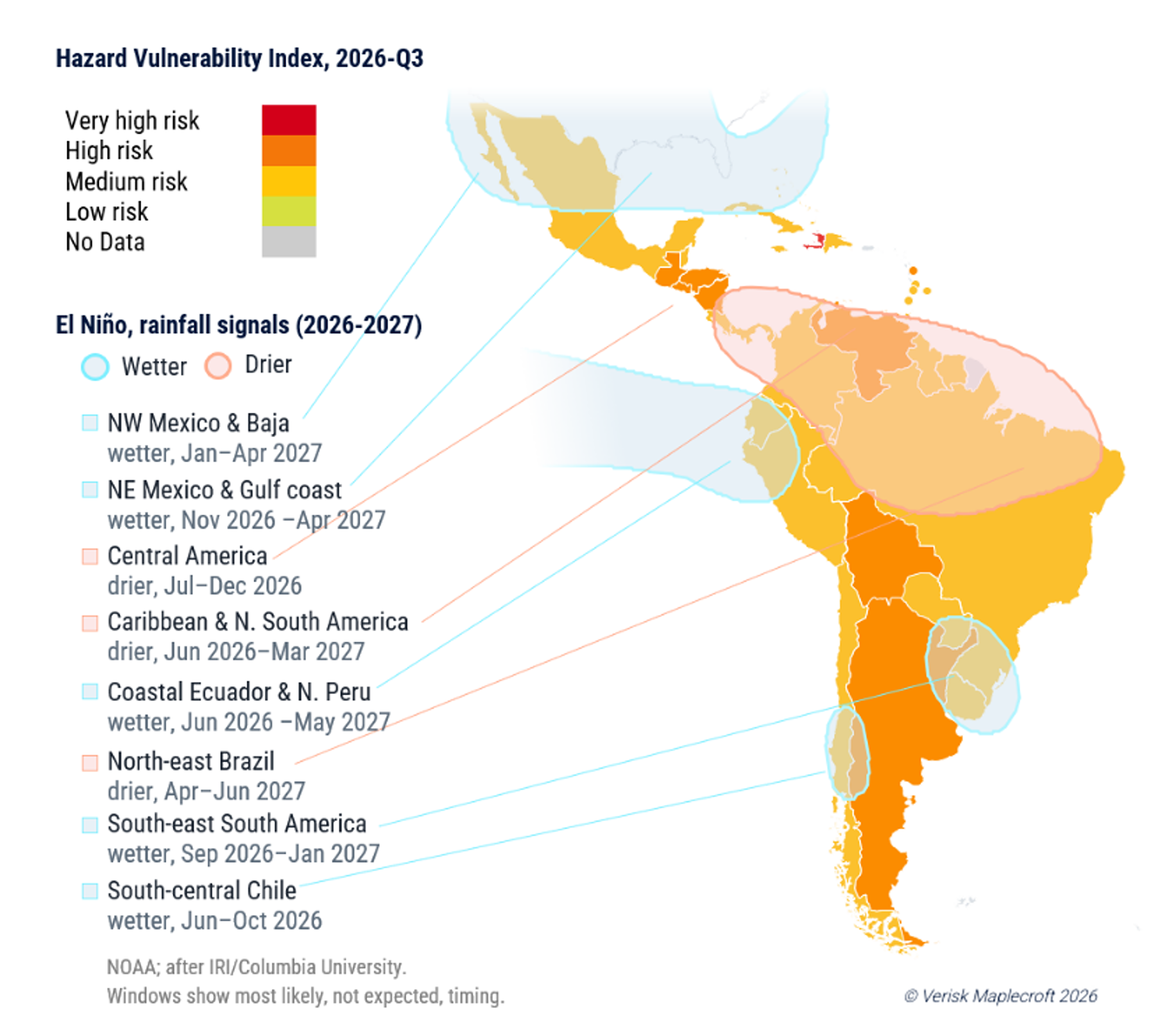
Venezuela, Colombia, Ecuador, Peru and Bolivia among most vulnerable
Our HVI reveals significant differences in countries' ability to absorb and respond to climate-related disruption. Central America and the Andean region (Venezuela, Colombia, Ecuador, Peru and Bolivia) emerge as the highest-risk subregions overall.
Nicaragua, Honduras, and Guatemala are not only the weakest performers in Central America, but across the entire region, while Venezuela, Bolivia and Argentina are the three most vulnerable nations in South America. Colombia, Brazil, Chile and Uruguay are comparatively better placed to absorb El Niño related disruption.
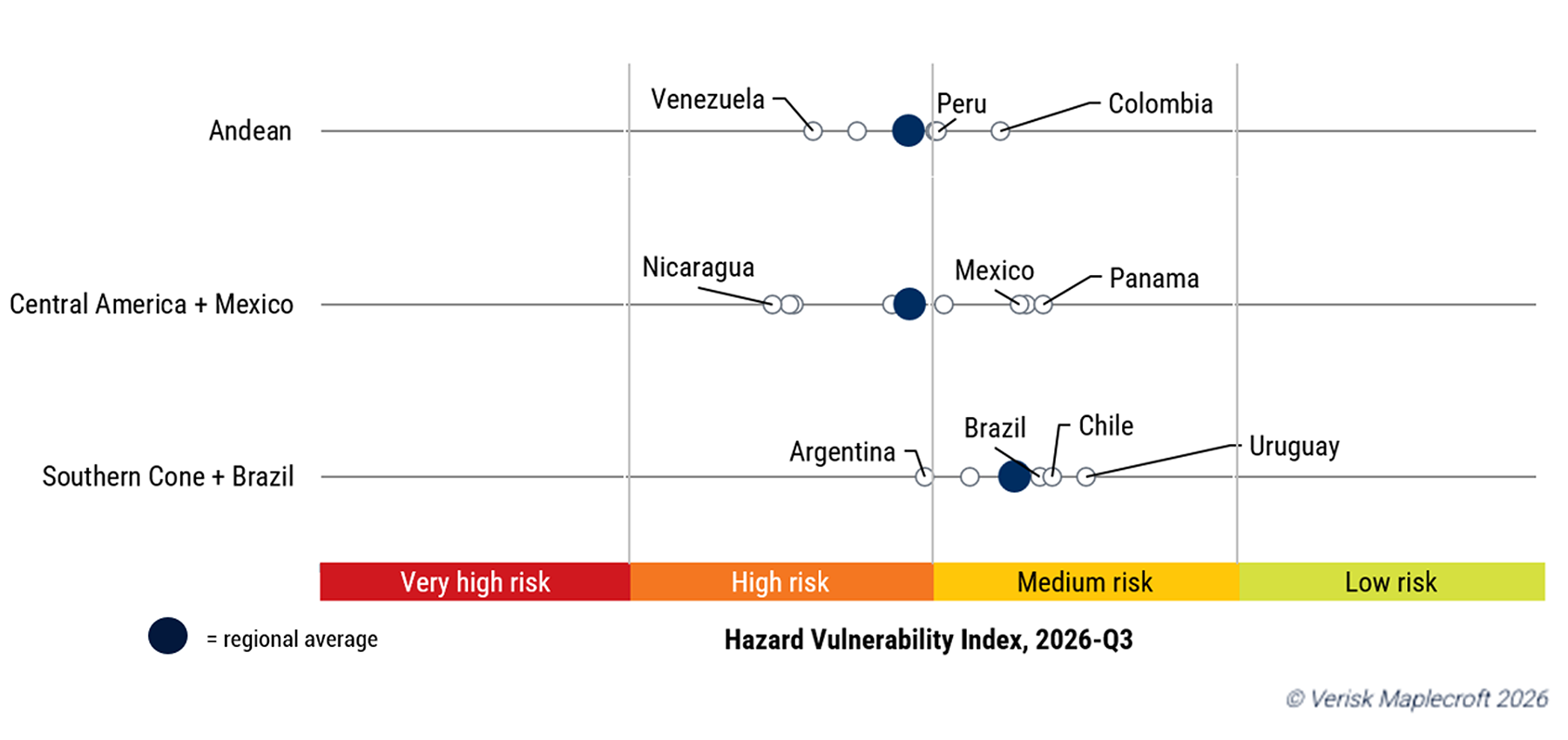
Weak governance amplifying potential disruption risks
In the Andean region, institutional strength, and in particular governance, which is key to the implementation of safety regulations, investment in resilient infrastructure and support for affected communities, is one of the main factors lowering its resilience to El Niño driven shocks.
For example, Venezuela’s reduced government effectiveness and legacy of underinvestment leaves the country with failing infrastructure, a dependence on hydropower plants stricken by plummeting water levels, and very few options to respond – as shown by the major earthquake in May, which left over 6,500 fatalities and severe infrastructure damage.
Similarly, a decade of political instability has corroded Peru’s institutional capacity. Much of the repair and mitigation work from 2017’s El Niño is yet to be completed, meaning this year’s rains in the north and droughts in southern regions will hit farming, industry, and infrastructure even harder. Mining is particularly sensitive to variations in rainfall: too little restricts output and too much threatens mines and access routes with floods and landslides. Copper prices hit a record USD6.50/lb earlier this year and any impact on supply could trigger even higher prices.
In contrast, Colombia, with the strongest institutional strength score in the Andean region, has moved to bolster resilience via emergency budget measures aimed at protecting hydroelectric generation and reinforcing disaster-risk management systems.
Drought threatens Central America and Panama Canal trade
One of the most high-profile impacts expected will be reduced water levels in the Panama Canal, which potentially has significant consequences for global supply chains, as around 5% of global maritime trade passes through the waterway. Increased restrictions on vessel transits would raise shipping costs, lengthen journey times, and further intensify pressure on logistics worldwide.
The canal’s exposure reflects a wider regional threat in the drought-prone “dry corridor” spanning Pacific coastal regions of Guatemala, El Salvador, Honduras and Nicaragua.
These countries display some of the weakest resilience in the subregion, particularly in relation to vulnerable populations and infrastructure quality. Shrinking rainfall will intensify water shortages, harming livestock and corn, maize, coffee and bean harvests.
Any resultant food insecurity and economic impacts will be compounded by constrained industrial production, mining activity and power generation, creating the conditions for migration and social unrest.
Southern Cone marked by localised risks
The Southern Cone typically benefits from stronger institutions, more resilient infrastructure and better access to emergency resources than much of the rest of Latin America. But the region’s importance to global food, energy and commodity markets means localised disruption could still have consequences far beyond national borders.
Southern Cone countries also illustrate how El Niño can create sharply different risk environments within a single market. In Argentina, increased rainfall could actually benefit soybean and grain-producing regions, as it did in the 1997 event. However, excessive rainfall can also cause flooding in north-eastern and river-basin provinces, which could disrupt planting and growing seasons, as well as roads, railways, storage facilities and access to export terminals.
Brazil is also set to experience greater rainfall in the south and south-east threatening agricultural areas in Mato Grosso, Mato Grosso do Sul, Goiás, Minas Gerais, and Bahia, which account for around 60% of all the country’s soybeans and 70% of all corn production. At the same time, drought in northern and Amazonian regions could constrain river logistics and hydropower generation. Prolonged disruption in these key export markets would tighten global commodity supplies of soy and other crops, increase price volatility, and force international buyers to diversify sourcing.
Figure 3: Uneven resilience will require sector-specific plans for continuity
Hazard Vulnerability Index and component scores by Latin American sub-regions
| Index / Indicator | Andean | Central America & Mexico | Southern Cone & Brazil | Likely business impacts |
|---|---|---|---|---|
| Hazard Vulnerability Index | 4.83 | 4.84 | 5.70 | Damage, disruption, losses, delays, costs |
| Historic Natual Hazard Index | 3.25 | 2.39 | 4.53 | Claims, repairs, downtime, losses, reconstruction |
| Natural Capital Buffers | 8.31 | 7.82 | 6.70 | Run-off, erosion, landslides, contamination, exposure |
| Economic Fragility | 2.54 | 2.96 | 3.94 | Insolvancy, credit, demand, financing, recovery |
| Quality of Infrastructure | 6.68 | 6.86 | 7.70 | Outages, closures, congestion, disconnection, delays |
| Institutional Strength | 3.51 | 3.83 | 4.77 | Warnings, coordination, enforcement, reopening, uncertainty |
| Emergency Resource Access | 5.59 | 6.11 | 7.07 | Rationing, shortages, healthcare, illness, disruption |
| Vulnerability Population | 6.90 | 6.39 | 6.86 | Displacement, absenteeism, evacuation, health, demand |
| Most exposed supply chains | Hydropower, mining, fisheries, coffee, freight | Grains, coffee, livestock, produce, shipping | Soybeans, grains, livestock, hydropower, logistics |
Source: Verisk Maplecroft
© Verisk Maplecroft 2026
Combination of El Niño and climate change poses critical test for business resilience
Businesses sourcing and operating in Latin America must prepare ahead of potential disruption within their supplier base and at specific operational locations:
- Map exposure by sub-region, not just by country. While drought concerns affect Central America, the Panama Canal and northern Brazil – flooding threatens Peru, Ecuador and southern Brazil, so overlay your suppliers and sites against these regions and our Hazard Vulnerability Index, prioritizing weak-governance countries like Nicaragua, Honduras, Venezuela and Bolivia.
- Plan for logistical alternatives and price shocks. With drought threatening maritime trade passing through the Panama Canal, businesses should model transit restrictions and higher freight costs, and diversify or hedge purchases of soy, corn, coffee, copper and salmon.
- Screen investments and operations by governance quality. Colombia's emergency measures to protect hydropower show how strong institutions soften the blow, while Peru's unfinished 2017 repairs and Venezuela's failing infrastructure demonstrate the opposite. Businesses should favour sites in better-placed countries like Colombia, Brazil, Chile and Uruguay, and investigate sector-specific continuity plans such as backup power and water for mines.
Find out how El Niño will affect food security in key Asian markets, or explore our Country Risk Data.