Argentina's opening is real and growing – but successful market entry will require the right risk data assessment and analysis
Argentina is back on the corporate watchlist. After years of capital controls, high inflation and policy volatility, President Javier Milei’s administration has steered the country through one of its most intense reform cycles since the return of democracy in 1983. The headline story is familiar: fiscal consolidation, deregulation and a renewed bid to position Argentina as a strategic supplier of energy, minerals and agricultural commodities.
But the investment case still depends on several factors. Macro-economic stabilisation is moving faster than households are recovering, the political calendar is already turning towards the next general election in 2027, and many of the assets drawing foreign interest are located in provinces where water stress, indigenous rights, environmental permitting and infrastructure gaps can reshape project economics.
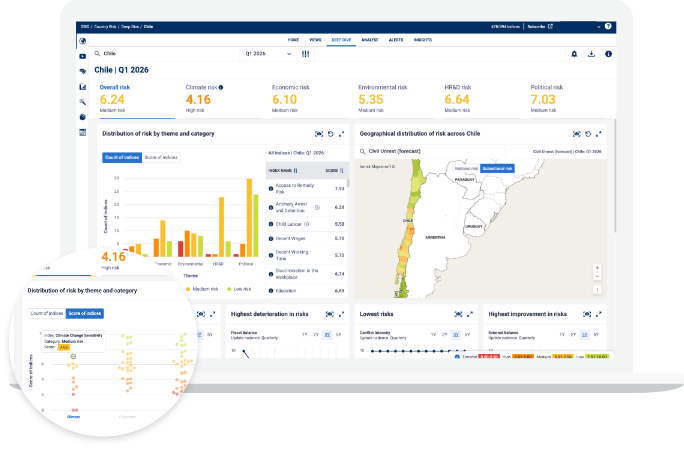
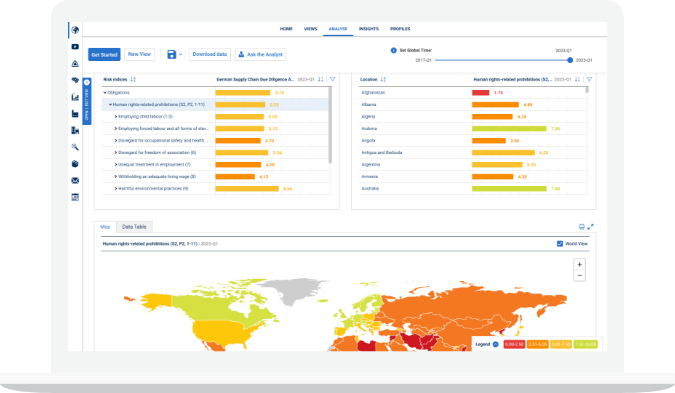
For businesses comparing Argentina with more geopolitically exposed markets, our data backs the country’s appeal as a novel diversification hub. As part of our Global Risk Dashboard (GRID), our new Deep Dive experience offers a fast, data-driven view that provides significantly more detail than a single country-risk headline, such as underlying risk trends, sector exposure and site-level detail. Successful business decisions around market entry will identify which locations combine policy support, market opening and manageable operating risk.
Thin reserves and labour strain test Argentina’s resurgence
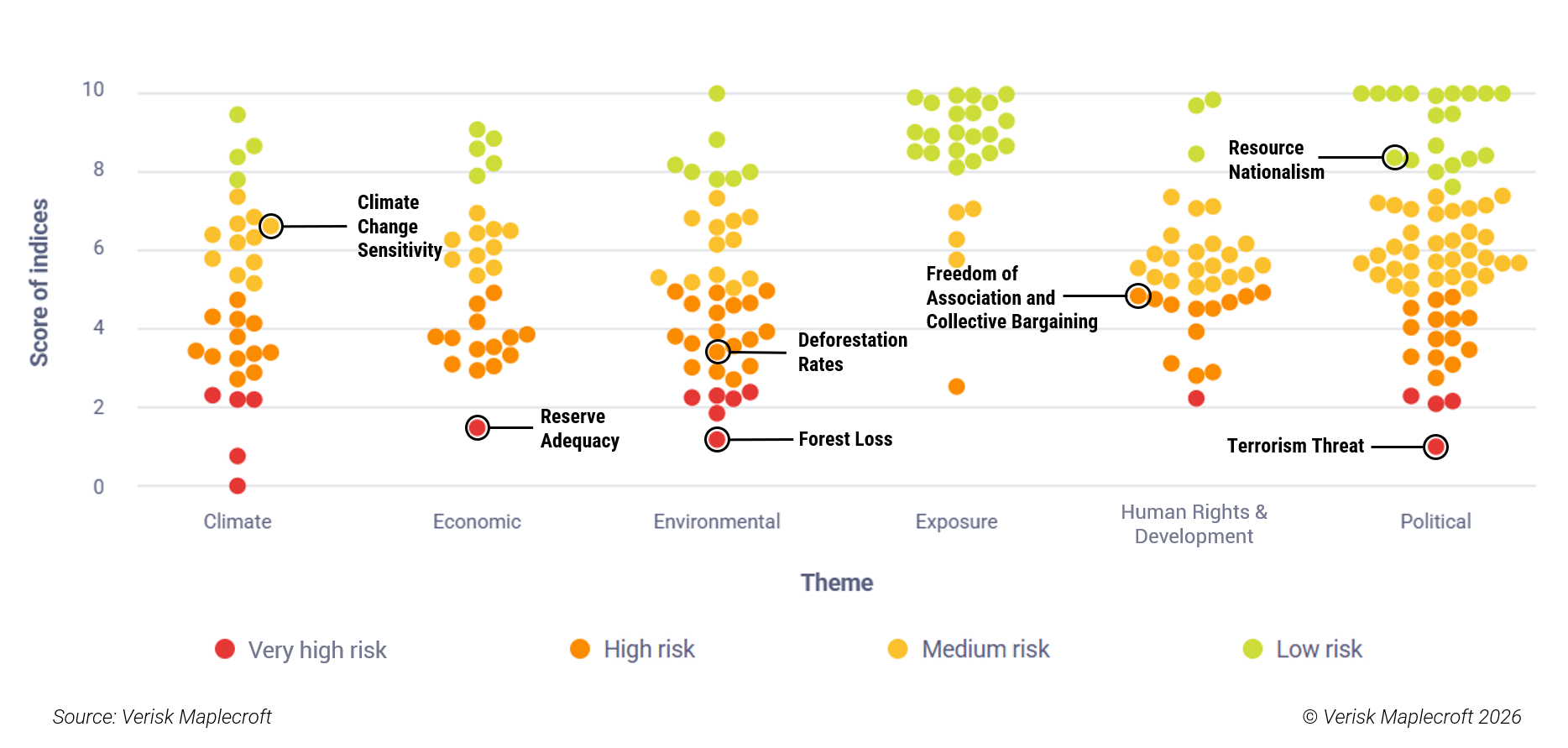
According to our 2026-Q3 data, Argentina's overall profile sits in the medium-risk band, with higher pressure on climate and environmental risks, a more mixed picture across economic, human rights and development, and political conditions; and a low-risk score on population and economic activity exposure. The weakest signals include carbon emissions from land-use change and forestry, total greenhouse gas emissions, and forest loss.
Argentina’s reserve adequacy score is especially important, as it captures a core vulnerability in the country’s stabilisation programme: accumulation of Central Bank reserves is being driven by a booming energy sector. Yet a precedent for boom-and-bust cycles makes monitoring mandatory for businesses exposed to FX, debt refinancing, import costs or dividend repatriation.
A newer warning also emerges. Our terrorism-related indices have weakened very significantly as Milei’s foreign policy has raised Argentina’s profile to hostile external threats. This is not the dominant operating risk for every company, but it matters for sensitive sites, critical infrastructure and business continuity planning.
Another area of increasing risk are domestic risks, with labour conditions requiring particular attention – as evidenced by our Freedom of Association and Collective Bargaining Index, and our Cost of Labour Index, both scoring as medium-risk. Argentina’s reform agenda is designed to make the economy more competitive, but the cost of adjustment is landing in a labour market already marked by informality, weak formal job creation and rising pressure on households. For companies, this creates a dual risk: higher sensitivity around labour relations and stronger political incentives for future governments to revisit parts of the reform agenda.
Figure 2: Terrorism and labour rights merit close risk monitoring
Argentina, highest-risk indices and sharpest three-year deterioration, 2026-Q3
| Highest Risk Indices | Score Q3 2026 |
|---|---|
| CO2 Emissions from Land Use Change and Forestry - SFDR | 0.00 |
| Total GHG Emissions - SFDR | 0.76 |
| Terrorism Threat | 1.00 |
| Forest Loss | 1.18 |
| Reserve Adequacy | 1.48 |
| 3-year Deterioration in Risks | 3Y Change |
|---|---|
| Terrorism Threat | ↓ -5.00 |
| Terrorist Financing Risk | ↓ -1.92 |
| Freedom of Association and Collective Bargaining | ↓ -1.65 |
| Cost of Labour | ↓ -1.32 |
| External Balance | ↓ -1.30 |
Source: Verisk Maplecroft
© Verisk Maplecroft 2026
Low conflict, policy changes, and reduced resource nationalism creating opportunities
On the flip side, our Deep Dive’s lowest-risk signals reinforce one part of the investment case: Argentina does not face the conflict profile associated with many other emerging markets (EMs). In 2026-Q3, the country had the lowest possible risk score for conflict intensity, exposure to regional conflict, and piracy and armed maritime crime.
More importantly, Argentina has recorded a positive improvement across multiple risk categories. Over five years, Deep Dive shows Argentina’s most notable improvements in inflation, resource nationalism, fiscal balance, borrowing costs, tax burden and financial openness. The country’s rebound on our Inflation Index leads the pack, driven by annual price increases closing at 31.5% in 2025 (down from 117.8% in December 2024). However, disinflation remains gradual, resulting in a persistent medium-risk score.
The resource nationalism shift is particularly relevant: in a global landscape dominated by governments increasing control over natural resources, Argentina is slowly – but steadily – heading in the opposite direction, with President Milei and his administration explicitly aiming to exert less state control over profits coming from resource exploitation.
Fiscal improvement is also key for commercial planning. It does not remove Argentina’s debt, reserve or exchange-rate risks, but it shows why investors are again willing to run scenarios around long-term projects. Deep Dive helps separate this improving investment backdrop from the operational risks that still sit beneath it.
Figure 3: Prominent opportunities stem from an improving investment environment
Argentina, Deep Dive, Lowest-risk indices and strongest three-year improvement, 2026-Q3
| Lowest Risk Indices | Score Q3 2026 |
|---|---|
| Conflict Intensity | 10.00 |
| Cyber Legislation | 10.00 |
| Exposure to Regional Conflict | 10.00 |
| Piracy and Armed Maritime Crime | 10.00 |
| Possession of Nuclear Weapons | 10.00 |
| 3-year Deterioration in Risks | 3Y Change |
|---|---|
| Inflation | ↑ +5.56 |
| Resource Nationalism | ↑ +4.35 |
| Borrowing Costs | ↑ +3.77 |
| Fiscal Balance | ↑ +3.21 |
| Economic Growth | ↑ +1.90 |
Source: Verisk Maplecroft
© Verisk Maplecroft 2026
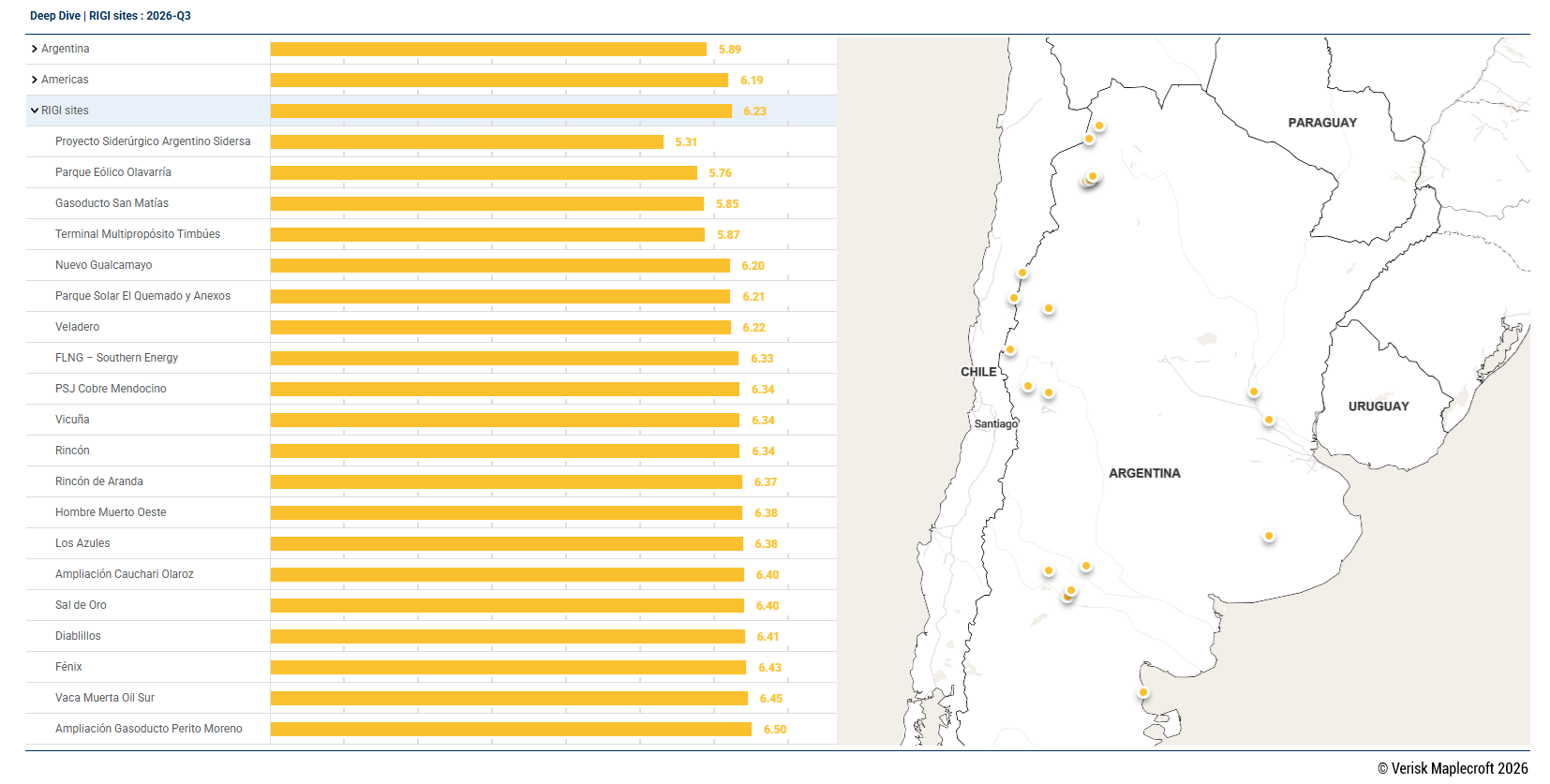
Argentina’s clearest opportunity as a novel diversification hub sits in the investment pipeline linked to the Regime of Incentives for Large Investments (RIGI) – the policy bridge between Argentina’s reform story and the capital-intensive sectors that global businesses are watching. The RIGI offers long-term tax, customs and foreign-exchange stability for large projects, with energy, mining, infrastructure and industrial assets at the centre of the government’s strategy.
Deep Dive lets users test that opportunity at the site level across the 20 confirmed projects in the pipeline. As a group, the RIGI sites score marginally above the Americas Deep Dive benchmark, yet clearly above Argentina's national Deep Dive benchmark. In other words, the government’s most favoured projects enjoy, on average, better risk conditions than the country as a whole. Sixteen of the 20 sites (80%) score above the national level, led by the Perito Moreno (6.50) and Vaca Muerta Oil Sur pipelines (6.45), followed by the Fénix lithium project (6.43).
That spread is the point, as RIGI improves the investment framework but does not make every project equally attractive. A gas pipeline, the expansion of lithium exploitation, a copper development or a port facility do not face the same infrastructure, environmental, labour, community or provincial governance risks. Deep Dive allows users to compare individual sites against the wider country profile and avoid relying on a single national average.
A credible investment opening, but not a low-maintenance one
For multinationals weighing entry into the Argentine market, the picture is one of complexity paired with genuine opportunity. The companies that get this right will be those that can pinpoint the specific locations where policy backing, market access, and manageable operating risk all line up.
Improving scores on resource nationalism, fiscal balance, borrowing costs, tax burden and financial openness support the case for renewed corporate attention. But Argentina’s weakest signals – on emissions, forest loss, reserve adequacy, labour relations and external balance – show why careful monitoring still matters.
Businesses should treat Argentina as a differentiated opportunity, not a uniform country bet. The priority should be to track risk by sector, province and site; to monitor whether the RIGI framework survives political pressure; to assess exposure to risks around water stress, social rights and environmental permitting; and to review labour and external balance risks quarterly rather than annually.
Our Deep Dive function on GRID is built for exactly that workflow: turning a country’s headline reform story into a structured, comparable and trackable risk picture.