Key Takeaways
- Conflict-driven fertiliser and fuel costs, and a record El Niño, are hitting Asian harvests simultaneously, compounding food insecurity across the region.
- Over half of South/Southeast Asia's most food-insecure countries also rank high for civil unrest risk, making price shocks a likely trigger for instability.
- South Asia faces the sharpest combined risk, with fragile new governments and top rice exporters both exposed heading into a more disruptive 2027.
Food security risks across South and Southeast Asia are set to rise, raising the potential for unrest and political instability in some of Asia’s most exposed economies, including India, Indonesia and the Philippines, according to our country risk data. The dual threat comes on the back of fertiliser shortages and rising fuel prices stemming from the Gulf conflict, alongside a likely record-breaking El Niño, which is already disrupting harvests ahead of a more disruptive 2027.
Geopolitical shock shifts from energy to food
While the impact of the Gulf conflict on oil and energy markets has dominated attention, food prices and availability could be more consequential, potentially stoking wider political and societal upheaval.
More than 75% of countries in South and Southeast Asia are already categorised as high- or very high-risk on Verisk Maplecroft’s Food Security Index, leaving the region extremely vulnerable to renewed pressure from food price inflation, an established trigger for unrest.
Worryingly, over half of these countries, including India, Indonesia, Pakistan, Bangladesh and the Philippines also sit within the two highest risk categories of the global risk data company’s predictive Civil Unrest Index. Rising prices are identified as a key driver of unrest risk in many of these economies by the index.
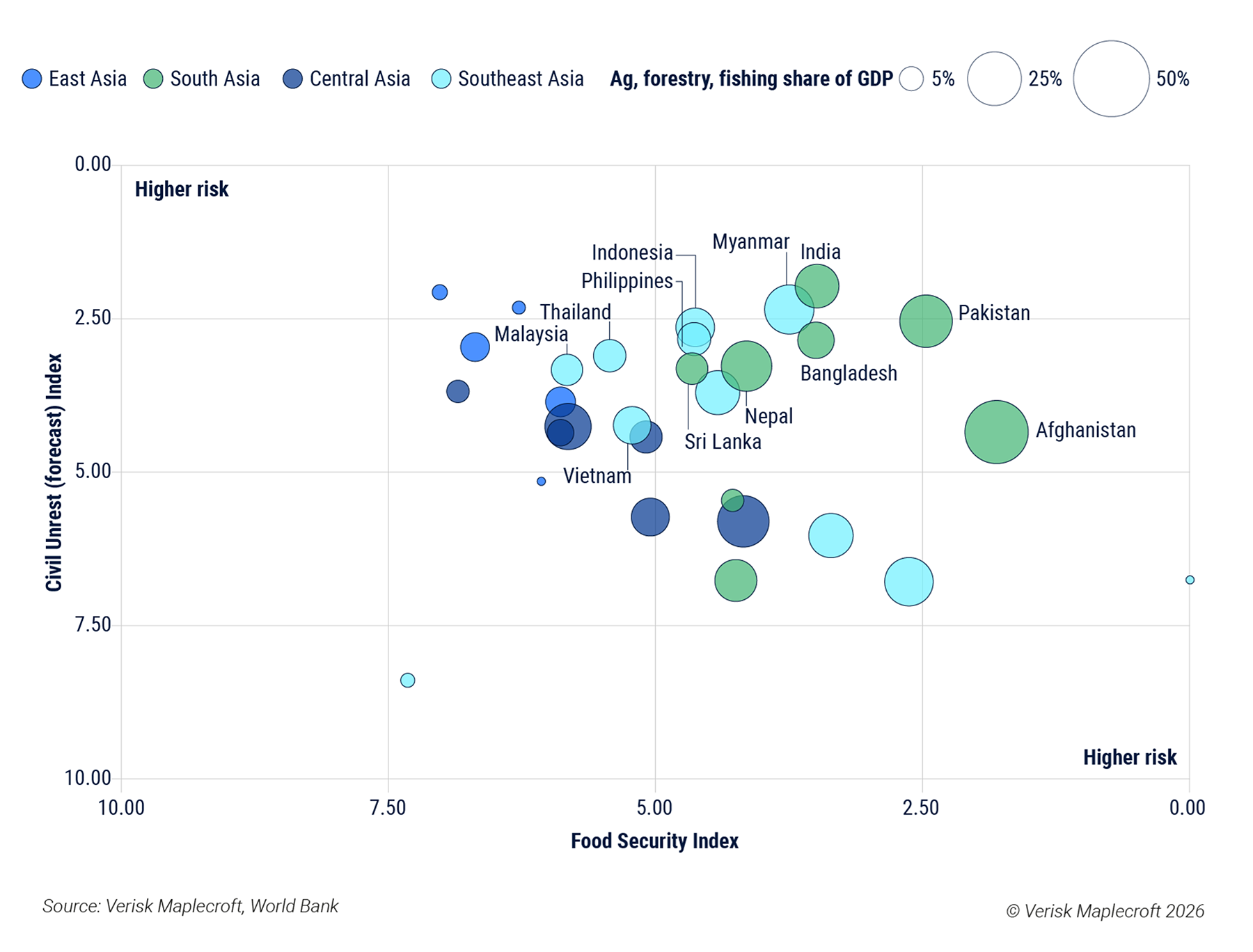
Fertiliser shortages and rising costs, as a result of the conflict in the Gulf, are driving up food security risks in many of these countries. Farmers have faced higher and more volatile fertiliser and fuel costs, as well as uncertainty over availability, at a point when resilience is already weakened.
The impacts are increasingly visible. In many key agriculture regions, planting and fertilisation decisions were made during the peak of the disruption, meaning negative impacts may now be locked in even if the geopolitical situation improves in the coming months.
El Niño adds a second pressure point for APAC
The current – and likely record-breaking – El Niño weather pattern adds a second layer of risk. Key agriculture zones in South and Southeast Asia are experiencing hotter and drier conditions including through a weakening of the South Asian monsoon. In addition to more severe heatwaves, less regular but more severe rainfall also raises the risk of crop damage from unexpected flooding following drought.
The risk is particularly acute for the world’s top rice exporters, including India, Thailand, Vietnam and Pakistan. Our data shows that, among these markets, only Vietnam sits outside the highest risk category risk for Water Stress, reflecting chronic strain on water resources even before disrupted El Niño rainfall patterns are factored in. Heatwaves and water stress also threaten palm oil harvests in Indonesia and Malaysia, with potential knock-on impacts across fuel and food supply chains.
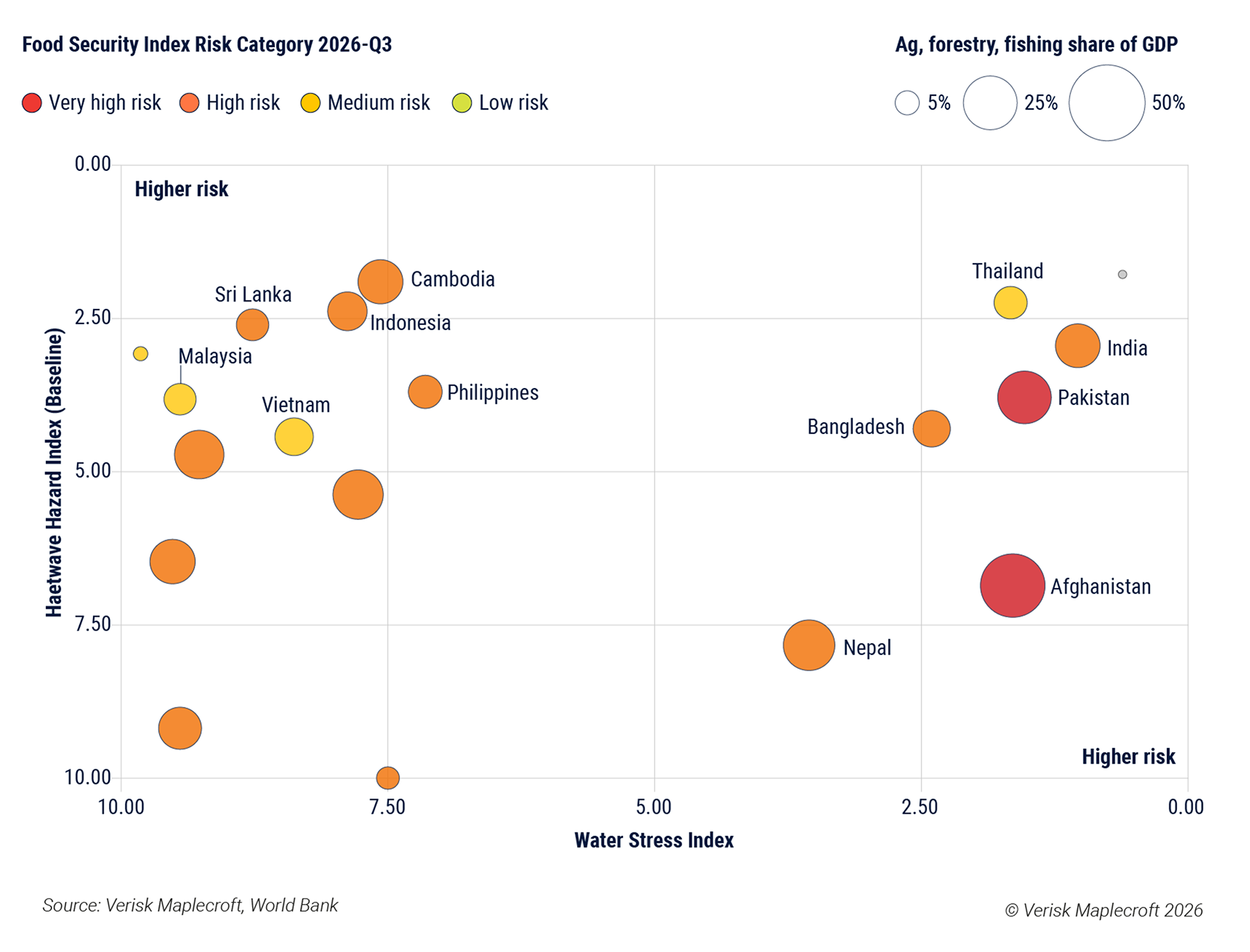
Indian government data shows planting of rice, soybeans and other summer crops tracking well behind previous years due to inadequate rainfall, before the gap closed as rain arrived in July. However, final yields are still heavily dependent on rainfall levels in September, as is the winter planting season.
India’s rice stockpiles are currently at record levels, but any production shortfall that puts pressure on domestic prices or availability would increase the likelihood of export restrictions, such as we saw during the 2023 El Niño. With other major rice exporters including Thailand, Pakistan and Vietnam also experiencing harvest impacts and rising prices, this would amplify the risk of shortages and price shocks for net importers such as the Philippines, Indonesia, Bangladesh and Sri Lanka.
South Asia faces the sharpest instability risks
Ahead of what is likely to be a very disruptive 2027, one of the chief concerns is that many of these Asian economies already face high food insecurity and elevated civil unrest risks. Verisk Maplecroft’s predictive Civil Unrest Index and Food Security Index point to South Asia as the subregion with the highest combined risk profile, followed by Southeast Asia.
Afghanistan and Myanmar are acutely vulnerable after years of conflict have repeatedly weakened societal resilience. Both countries are already in food crisis, and any additional external food shock would raise the risk of a humanitarian catastrophe.
Bangladesh, Sri Lanka and Nepal form a second cluster of highly exposed markets. All three are emerging from recent political and economic crises and have new governments installed following youth-led protest movements. Managing food security and cost-of-living pressures will be a defining test of their legitimacy. September has already seen farmers protesting over access to fertiliser in several districts of Bangladesh. In Southeast Asia, protests against rising prices have emerged in the Philippines and Indonesia, where protests in recent weeks and last year turned violent, particularly in urban and regional administrative centres. Civil unrest risk is particularly elevated across Java, Indonesia’s rice-basket, compared to the rest of the country. Thailand could be next. Its government is highly reliant on imported energy and fertilisers, has a widening fiscal deficit and is under growing pressure from debt-challenged farmers entering the next planting season with reduced resilience.
Persisting risk for multinational businesses
The data suggest if food price and availability pressures intensify, and governments are seen to respond ineffectively, unrest and political instability could emerge in these higher-risk markets. Multinational businesses should:
Diversify sourcing and stress-test contracts for rice, palm oil and other agricultural commodities, since top exporters like India, Thailand, Vietnam and Indonesia face rising risk of export restrictions or supply disruption.
Plan at the sub-national level, not just country level, since unrest risk is concentrated in specific hotspots like Java, Indonesia, and parts of Bangladesh and the Philippines.
Treat post-uprising governments (Bangladesh, Sri Lanka, Nepal) as early-warning signals, since fragile political legitimacy makes them likely to show instability first as food pressures continue to build.
The interaction between conflict, climate and food systems will shape instability risks across the Asia-Pacific region into 2027. The outlook points to a prolonged period of volatility, where geopolitical disruption will remain a driver of food security risk even with improvement in Gulf conflict outlooks.