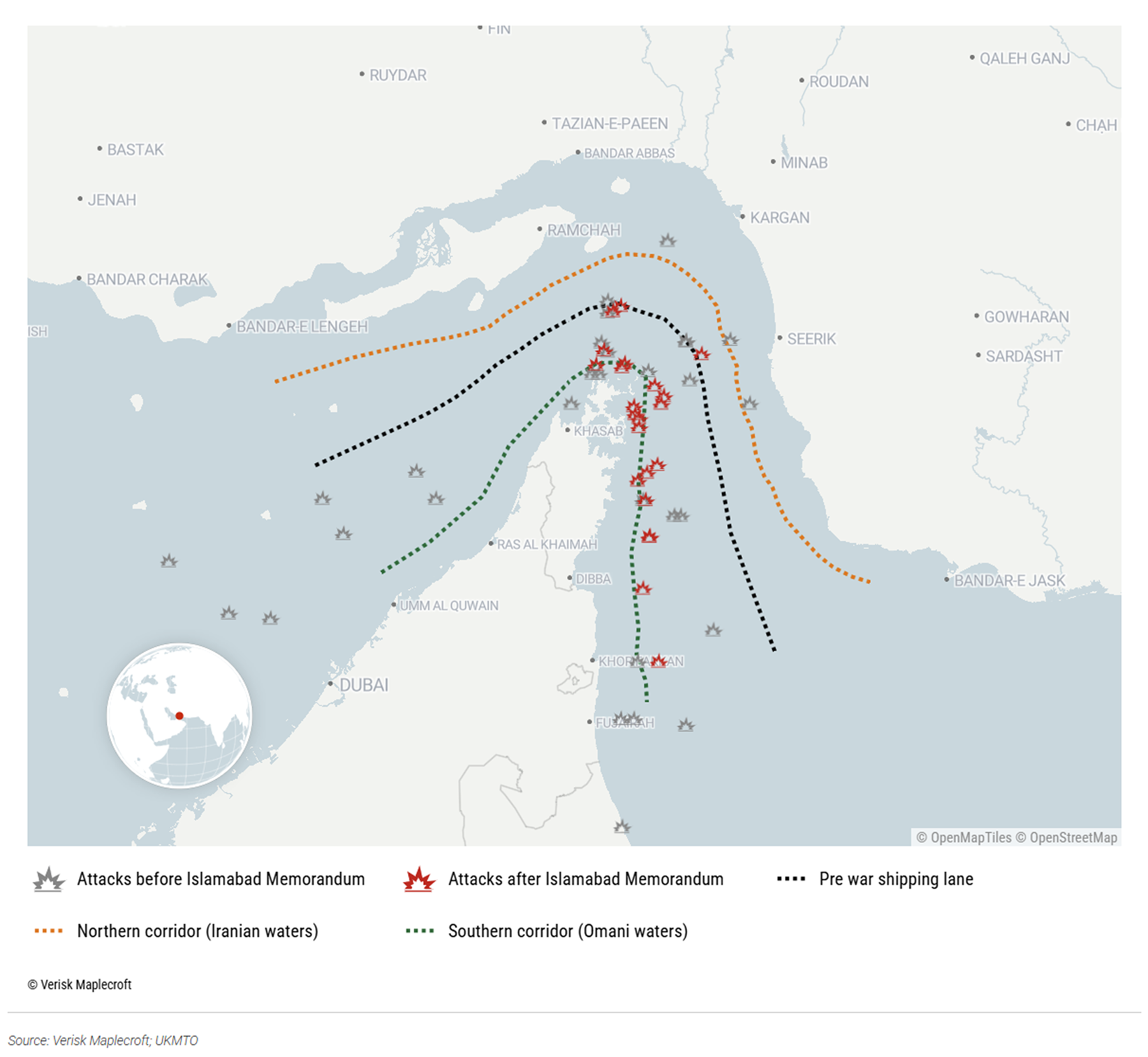
Our Supply Chain Risk Outlook, released earlier in 2026, focused on increasing trade risk and the rising number of acute threats to ports globally. Since the Outlook, there has been no indication of a reversal of these trends; maritime risk continues to rise in both frequency and geographic spread. All types of fast-moving risk factors were considered originally, including environmental and domestic security risks, but expanding conflict remains the clearest driver for heightening maritime risk; conflict now impacts 6.5% of inhabited global territory according to our Conflict Intensity Index.
Since February 2026, Iran has unleashed an unprecedented series of attacks on commercial shipping in response to the US-Israel offensive, sparking a crisis in the Strait of Hormuz that continues to roil global energy markets and geopolitical positioning. But maritime risk is also not isolated to just Hormuz, with maritime attacks recorded this year in the Black Sea, Caribbean Sea, Red Sea, and the Mediterranean Sea.
With geopolitical relations fragmenting, the international norms and cooperation that previously underwrote the flow of international maritime commerce are likely to weaken. In this context, any company that relies on maritime supply chains will have to shoulder increasing responsibilities and costs associated with risk management and mitigation.
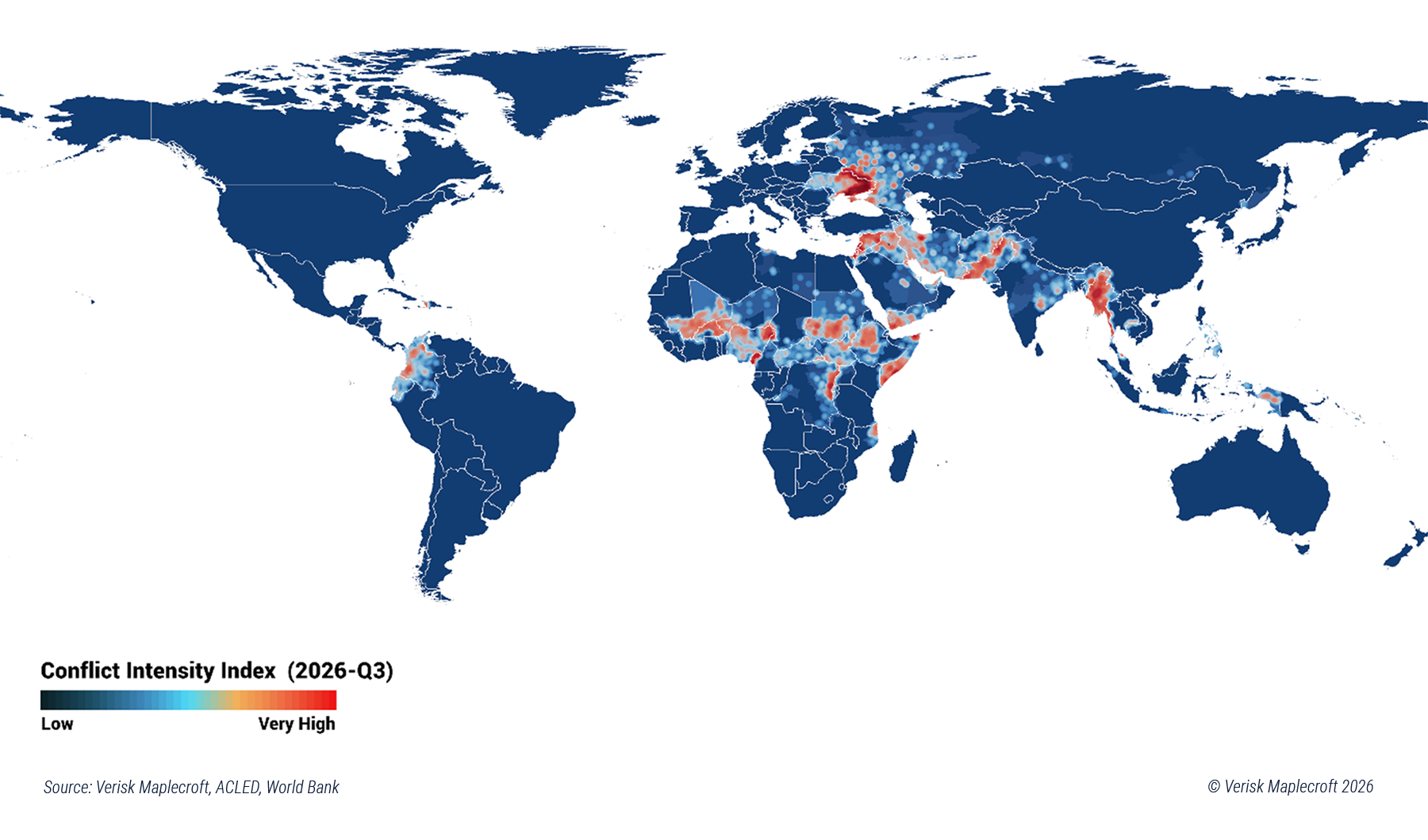
Hormuz remains as a maritime conflict flashpoint
Since the start of the US-Iran war in February, more than 65 commercial vessels have been successfully targeted by Iran – establishing its threat to the Strait of Hormuz as the primary leverage in negotiations with the US. Crucially, it has achieved this without the capabilities of a conventional navy. Instead, drones and missiles fired from Iran’s interior continue to hit commercial vessels attempting to transit the strait via the southern corridor as Iran seeks to set the terms for a resolution.
The world is taking note. Ukraine’s campaign against Russia’s shadow fleet expanded rapidly this year, with long range drones striking tankers and grain ships in the Black Sea. Moscow has responded in kind. Russian vessels were also hit by explosions off the coast of Libya in March and in the Gulf of Oman in June. Ukraine has not formally taken responsibility for these attacks, but its involvement is likely, indicating that Kyiv is prepared to wage its naval campaign against Russia far beyond the Black Sea. Even the US has targeted commercial ships belonging to Iran’s shadow fleet, with at least 22 vessels disabled by the US Navy as part of its blockade on Iran.
Low-cost, high-impact maritime attacks could become widespread
Maritime attacks can, and likely will, be employed elsewhere as a means of disruption. Low-cost drones and the asymmetric expense of intercepting them hand an advantage to the attacker, particularly when unarmed commercial vessels are the target. Such attacks are predominantly linked to the Iran and Ukraine wars for now, but drone technology and tactics are proliferating on land in jurisdictions as varied as Colombia and Myanmar; it’s therefore conceivable that armed actors begin looking to the sea for new forms of leverage.
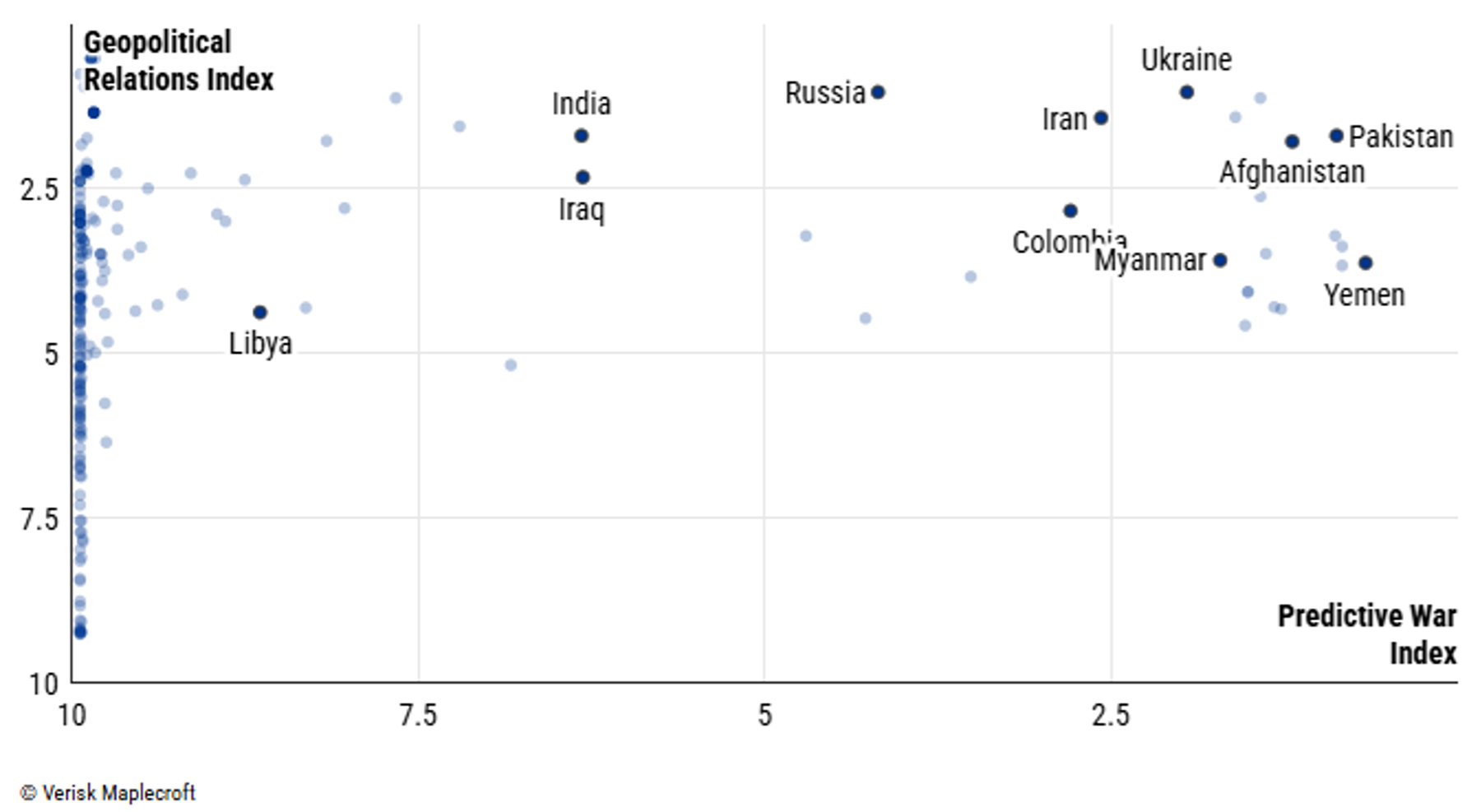
Attacks on commercial ships from countries where civil war has severely weakened institutions – both Libya and Yemen are extreme risk on our Challenges to Government Authority Index – show how unstable jurisdictions can become cauldrons of, and launch pads for, maritime disruption. The Yemen-based Houthis, and the threat they pose to the Bab el-Mandeb chokepoint, are the leading example of this.
The impact of Middle East maritime conflict on global trade is, of course, supercharged by the circumstances of geography – the straits of Hormuz and Bab el-Mandeb are crucial shipping chokepoints. But this can obscure the localised consequences of shipping disruption, as the results of Ukraine’s campaign against Russia’s shadow fleet show. The fact that attacks on commercial shipping are increasingly viewed as legitimate also raises the risk that, in future conflicts, other shipping chokepoints will be drawn into the line of fire.
Navigating a new era of maritime risk
The past six months point to a structural shift, not a temporary disruption. Maritime attacks are proliferating and businesses can no longer manage risk by watching one chokepoint and assuming the rest of the network is stable.
- Route exposure needs continuous reassessment. A route deemed safe today may not stay that way. Our Conflict Intensity Index, Predictive War Index and other geopolitical and domestic security data give businesses visibility into escalating conflict threatening crucial shipping lanes.
- Sourcing decisions must weigh state fragility. Libya and Yemen show how weaker governance can turn a country into a launch pad for maritime disruption. Our Challenges to Government Authority Index helps to flag these risks in advance and informs supply chain decisions before disruption occurs.
- Cost strategies should treat elevated risk as the new normal. Market adaptations have blunted the economic shock of maritime conflict, which has weakened the pressure to resolve it. Businesses should build this premium into procurement and insurance planning as a longer-term cost instead of just a temporary spike.
Verisk Maplecroft's risk indices give procurement and risk management teams the data to build early-warning capability into sourcing, routing, and insurance strategies – turning maritime intelligence into a competitive advantage rather than a reactive cost.