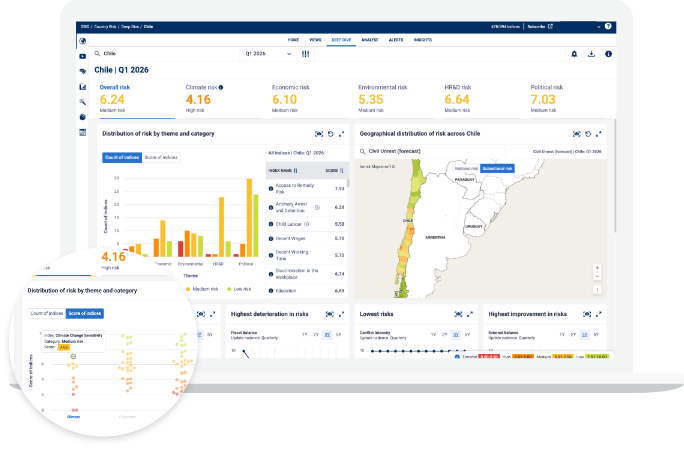
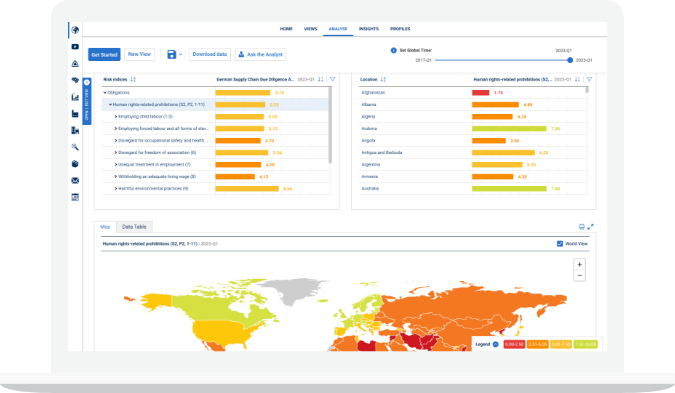
India is a market that global businesses cannot afford to overlook. Its scale, economic and development trajectory, and geopolitical position will place it at the heart of global growth over the next decade. Using analysis from our “Deep Dive” view, as part of our Global Risk Dashboard (GRiD), we see that the business environment remains complex and demands a nuanced understanding of the risk landscape – particularly for foreign firms.
Prime Minister Narendra Modi and his Bharatiya Janata Party (BJP) have dominated Indian politics since 2014, pursuing two priorities: reforming the business environment and promoting a Hindu nationalist (Hindutva) identity at home and abroad. These ambitions have supported world-leading economic growth and rapid development, while also deepening communal tensions and prompting international scrutiny of India’s human rights trajectory.
India’s multi-alignment strategy underpins its economic potential, positioning the country as a leading alternative to China for supply-chain and investment diversification. At the same time, geopolitics remains a significant risk: the May 2025 conflict with Pakistan crossed new thresholds of severity, while relations with Beijing continue to be constrained by unresolved border disputes.
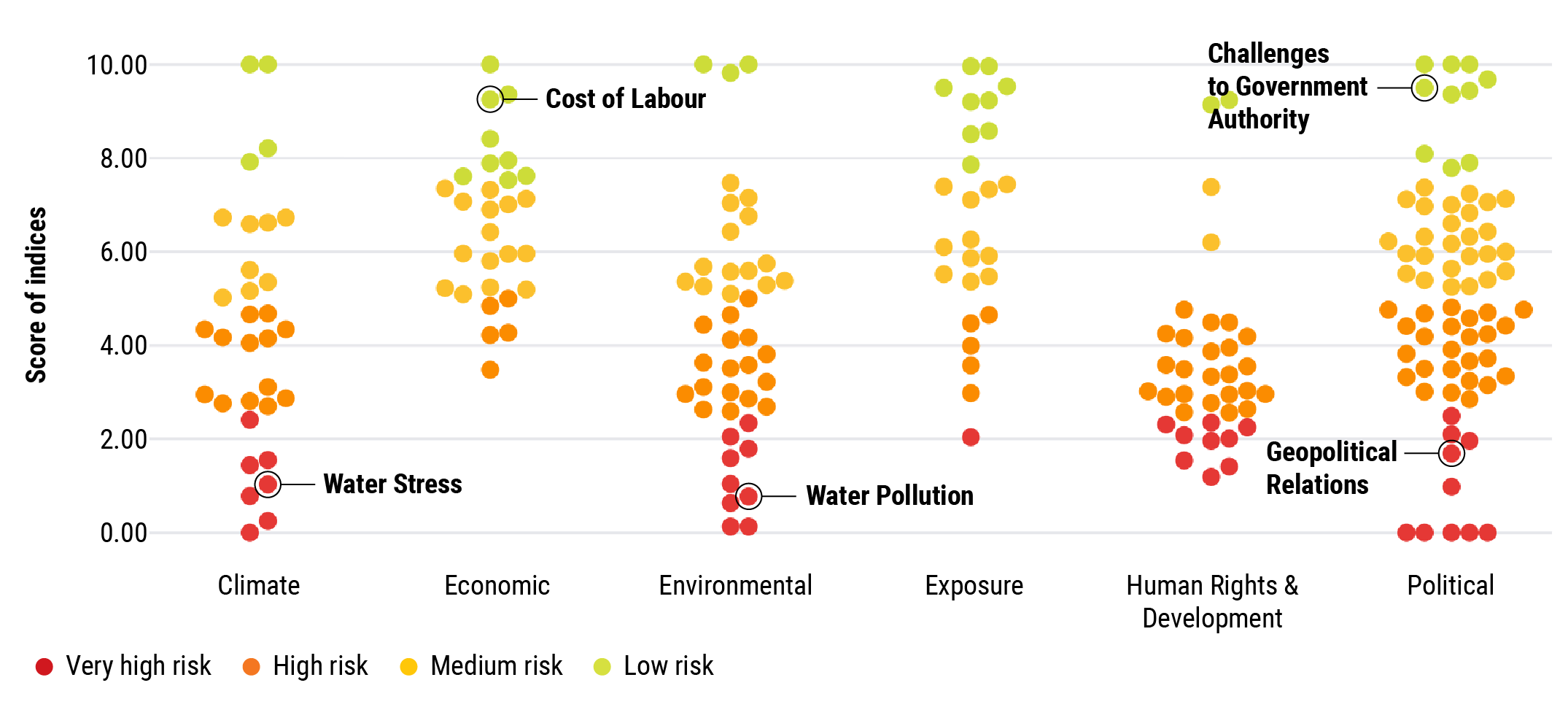
India’s risk landscape is broad and interconnected. Its Deep Dive profile carries an overall high-risk rating, while every sub-theme falls within the high- to medium-risk range – as shown in Figure 1.
Civil unrest
Our Deep Dive highlights civil unrest as among India’s most significant risks. Our forecasted Civil Unrest Index assesses the risk of disruption to business caused by the mobilisation of societal groups in response to economic, political, or social factors. The index focuses on the short-term future risk of civil unrest by forecasting the expected scale of civil unrest activity in a country in the next 12 months.
India scores as “extreme risk” on this index, with key drivers including communal tensions – which have been intensified by the BJP’s Hindu nationalist agenda – and broader socioeconomic grievances.
An important development this year was the emergence of a new youth-led movement – the Cockroach Janta Party (CJP) – which has secured unprecedented government concessions. The CJP, which began as an online joke after India’s chief justice compared unemployed young people to cockroaches, has recently organised peaceful demonstrations in the capital calling for education reform. Heavy-handed policing drove escalation and channelled previously unexpressed anti-incumbency sentiment. In a rare government reversal, the first phase ended with the education minister’s resignation.
The CJP’s future direction remains uncertain, but its rapid growth has highlighted the breadth of the underlying grievances related to employment opportunities, social mobility, and governance. While the latest protests may subside, they reinforce a broader pattern of persistent unrest capable of disrupting business operations and damaging commercial property.
Political trajectory
India’s low risk score on our Challenges to Government Authority Index underlines Modi’s remarkably secure tenure, yet the BJP’s future trajectory remains a material business risk given its central role in India’s growth story and the unresolved question of Modi’s successor. While the party’s ideological foundations are likely to endure, some successor profiles could favour a more divisive Hindutva agenda over domestic stability and reform.
This uncertainty is compounded by weak opposition. Recent election defeats for key opposition leaders in West Bengal and Telangana further emphasise India’s lack of viable national challenger to the BJP.
Environmental risks
India’s environmental risk landscape poses tangible challenges for companies operating in the country and is identified in our Deep Dive profile as one of the two highest risk themes.
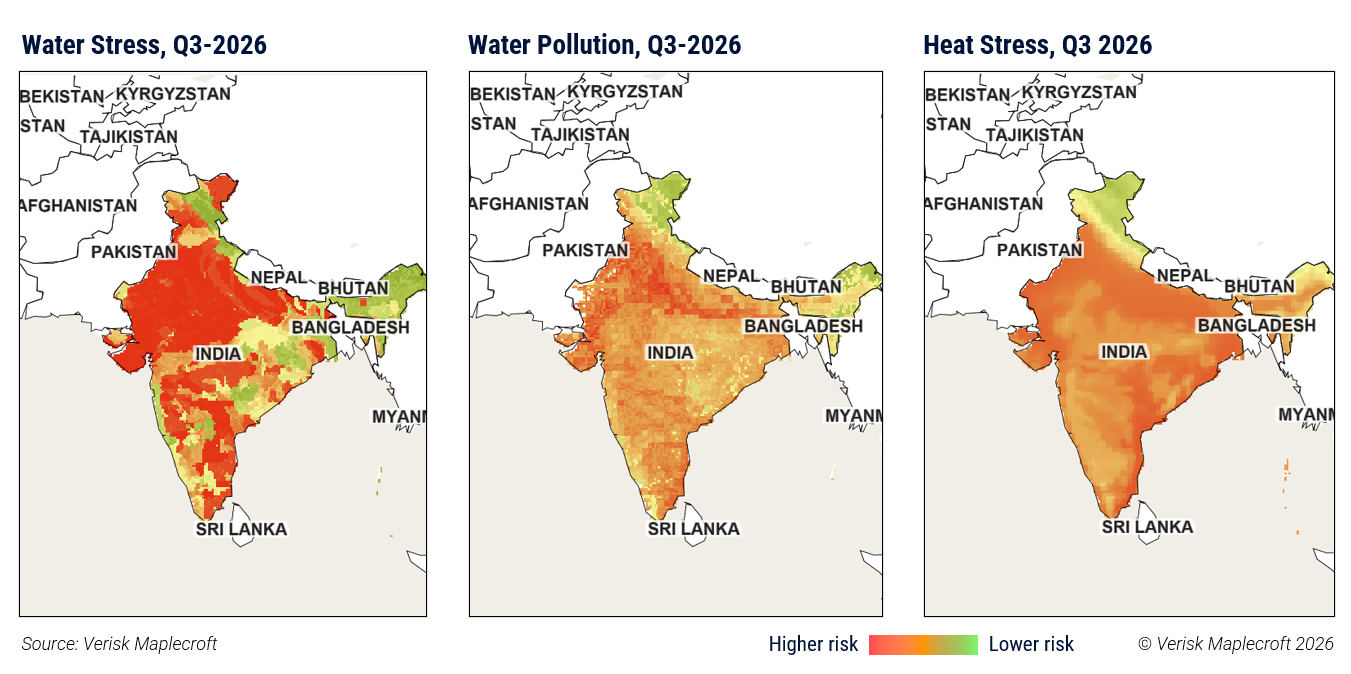
India has extreme risk scores across key metrics relating to high temperatures, water quality and availability, and natural hazard exposure. These scores also reflect that droughts, floods, heatwaves, and storms are likely to become more frequent and severe over the coming century due to climate change, increasing the risk of business disruption. The map below illustrates the subnational distribution of water stress risk across India, with key tech sector hubs among the highest risk locations. In 2019, Chennai faced acute water shortages, forcing major manufacturers to adjust their operations.
The current El Niño weather pattern is intensifying water stress across India by weakening the monsoon. The most direct impacts will be felt in the agriculture sector, but water intensive industries could also face restrictions should localised shortfalls occur.
Energy resilience
Within the political risk theme, we’ve assessed the fourth biggest increase in risk over the last three years to be energy resilience, reflecting India’s structural exposure to disruptions in global energy markets. This is a result of its high import dependence, low energy self-sufficiency and limited energy-consumption diversity. The ongoing disruption to transit via the Strait of Hormuz has put real strain on India’s energy security, leading to increased costs and operational pressure for businesses.
Opportunities for market entry
Our Deep Dive profile highlights that India’s low cost of labour remains a key opportunity for multinational companies, with India still cost competitive relative to regional peers. This includes in the flagship electronics manufacturing sector, where India has increasingly attracted major international players.
India’s government has also made clear its intention to play a key role in global AI developments, and business opportunities will concentrate in deployment, consumer services and data-driven applications. India has a high-risk but improving score on our assessment of digital inclusion, with adoption expanding rapidly.
Beyond tech and electronics, India’s openness to foreign investment has accelerated in the last year, creating new options for multinational business. Geopolitics has been a key driver, with US tariff policy prompting the government to double down on diversification, ramping up efforts to seal long-awaited trade deals. This includes the India-EU trade deal signed in February, the India-UK deal which came into force in July 2026, and the India – US deal currently under negotiation. This has been matched by the full or partial opening up to foreign investment of previously restrictive sectors, including insurance, defence, and, most recently, e-commerce.
However, India’s opportunity landscape is still evolving. Further reform to issues like land acquisition as well as other bureaucratic and governance hurdles would add to the upside potential.
India presents a compelling mix of huge scale, a pro-business reform trajectory, and a potential geopolitical sweet spot. However, multinational businesses seeking to capitalise on India’s potential should be aware that detailed understanding of risks and opportunities at both federal and state level is essential.