The severe blazes raging across Europe this summer have naturally driven wildfires towards the top of risk agendas for business and investors. But as climate change takes further hold, the frequency, impacts and costs of these incidents are set to soar for the largest companies in the region as their operations and assets become increasingly exposed.
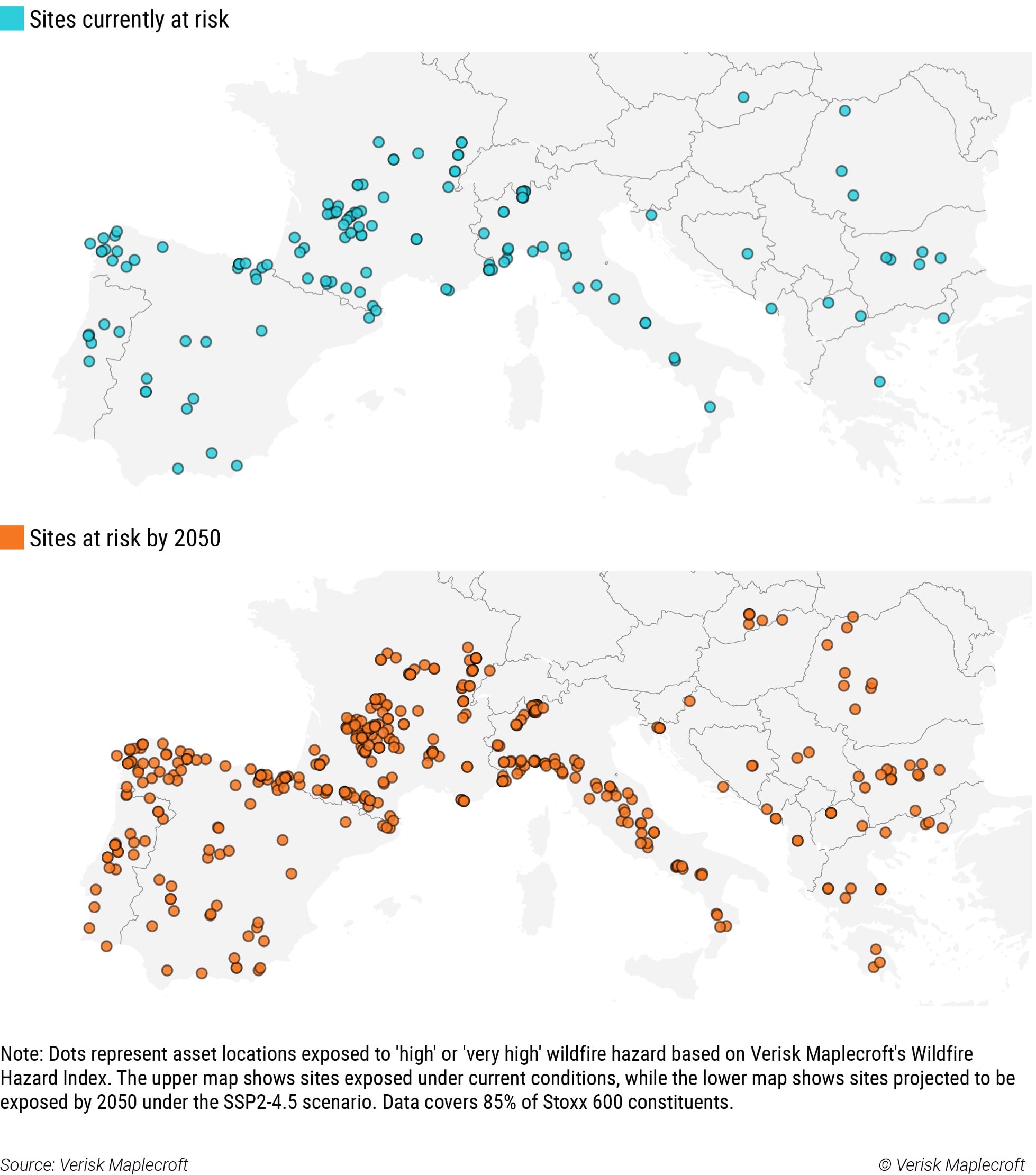
Tracking companies across Europe’s key benchmark, the Stoxx 600, our Asset Risk Exposure Analytics (AREA) measured the locational exposure of 30,000+ listed companies globally against 85+ risks and found that $18 billion of corporate value is currently located in places that are at ‘high’ and ‘very high’ risk for wildfire hazard. However, by 2050, that figure is projected to rise to $249 billion, an increase of 1,283% over today’s level – under an “intermediate” emissions scenario (2.7°C warming, SSP2-4.5).
Southern Europe is expected to remain the region’s wildfire hotspot, but it is Western Europe that will likely experience the highest intensification. The share of Western European assets exposed to ‘high’ or ‘very high’ wildfire hazard is projected to rise from 24% to 43% by 2050, a 79% increase, while France is projected to experience the largest increase, with exposure growing more than sixfold.
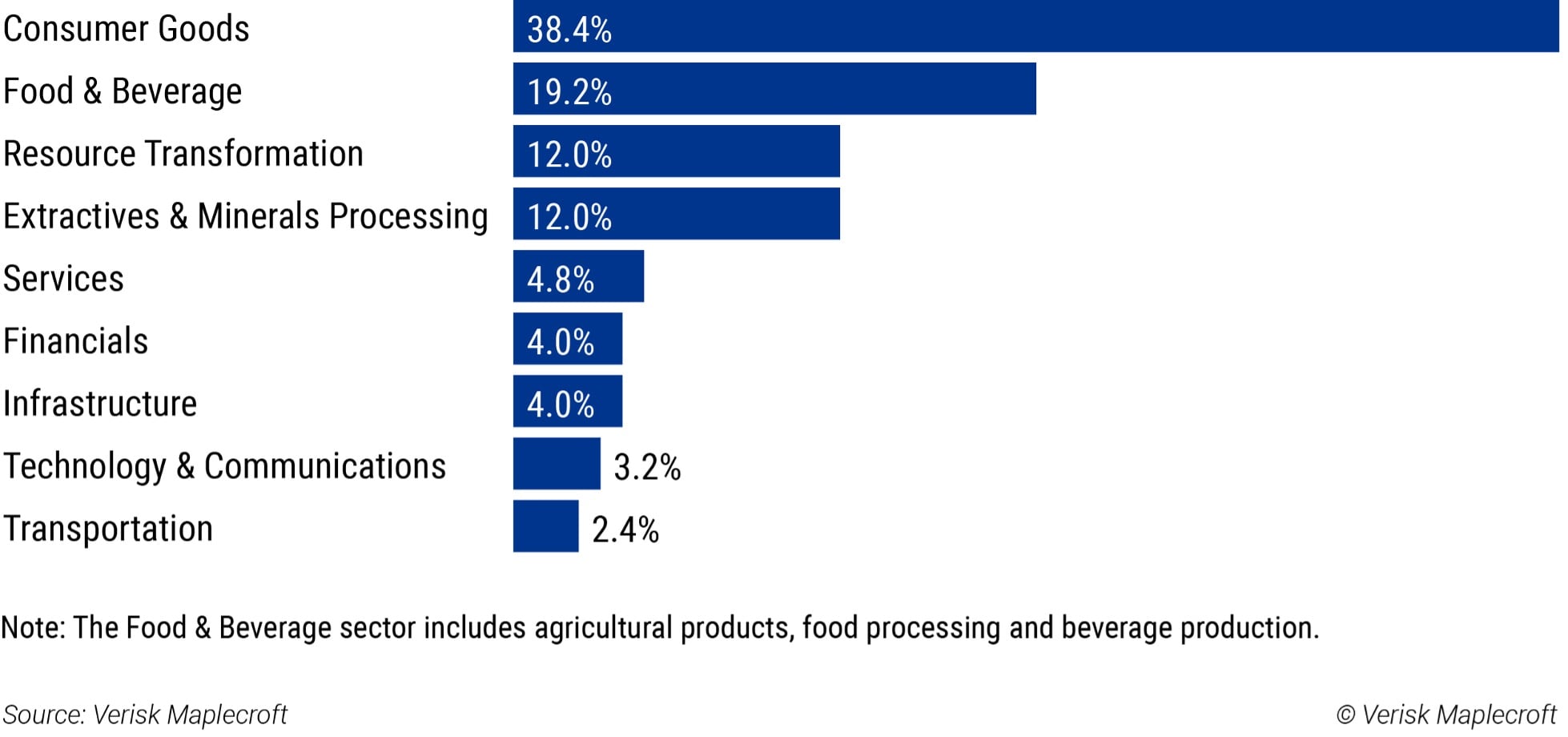
Exposure varies across European economy sectors
European wildfire exposure is concentrated in two distinct sector profiles. Consumer-facing sectors carry the largest share: consumer goods (38.4%) and food and beverage (19.2%), which includes industries ranging from agricultural products to food processing and beverage production, together account for 57.6% of Stoxx 600 asset locations at ‘high’ or ‘very high’ wildfire hazard. These assets — production facilities, distribution networks, retail footprints — cluster in urban and urban-fringe areas. While urban locations themselves have lower burnability according to our index, rising wildfire exposure is being driven by worsening hazard conditions, including higher temperatures, lower humidity and increasing drought risk. Exposure is also growing as development increasingly encroaches into the wildland-urban interface, creating greater overlaps between built environments and fire-prone landscapes.
Asset-heavy industrial sectors, meanwhile, are also highly exposed. Resource transformation, including industries such as aerospace, chemicals and industrial machinery, and extractives & minerals processing together account for around 24% of exposed assets. Unlike the consumer-facing sectors, these operations are often located in rural and urban-fringe areas, in some cases adjacent to natural forests or other uncultivated lands. Exposure is therefore more direct, increasing the likelihood of physical damage to fixed sites and operational shutdowns.
While not explicitly measured by our Wildfire Hazard Index, the risks to business extend beyond physical damage to on-the-ground assets. The potential for business interruption is just as material, and it plays out differently across the two exposure profiles. For consumer-facing sectors clustered in urban and urban-fringe hubs, smoke and poor air quality can suppress workforce productivity, while businesses may be forced to close where staff are unable or unwilling to travel, or where consumers cannot access retail and service locations.
Localised fires can compromise power and digital infrastructure as well as access to distribution and retail networks. Dense interdependencies mean a single event can disrupt multiple operations simultaneously. As exposures cluster geographically, these shocks can start to take on more systemic characteristics at the portfolio level. For asset-heavy industrial sectors, the disruption is more direct: damage to fixed sites, forced shutdowns, and the loss of output that follows.
In both cases, wildfire events can result in operational downtime, higher insurance and compliance costs, and damage to physical assets. Where multiple institutions share the same geographic exposure, these impacts can put additional pressure on earnings and market sentiment.
From mapping risk to building resilience
For equity investors, the implication is that sector-level exposure figures could understate the real picture. Two sectors with similar headline exposure can face wildfire hazards through entirely different channels. Within sectors, there can be significant variation in exposure depending on the location, density and clustering of individual sites, including retail networks, logistics infrastructure and operational facilities.
These findings point to the potential underpricing of risk in European equities. Incorporating location-specific exposure data refines how risks are identified and assessed across the investment process, from initial screening and fundamental analysis through to portfolio construction and risk monitoring. Across a portfolio, it can also highlight hidden concentration risk that isn’t visible from sector or company-level analysis alone.
For investors, the value of this granularity informs portfolio resilience. Understanding where risk concentrates, and where it compounds across holdings, allows for more targeted engagement with investee companies on adaptation and operational continuity. It informs better-calibrated capital allocation across regions and sectors, and stronger positioning of portfolios for a climate environment in which physical risk is becoming a material driver of returns. As summers become hotter and drier, that resilience will increasingly distinguish portfolios that have absorbed the shift from those still pricing wildfire as a tail risk.
Find out more about our Wildfire Hazard and Climate Risk and Nature solution.