Our newly released trade data can help businesses monitor a country's trade risks and resilience – helping to identify how a country's trade profile could affect operations and supply chains in the event of trade disruption.
In a globalised economy, a country's trade defines its position in the global value chain. Exports reveal global appetite for a country's production; imports reflect how much it depends on foreign goods to sustain domestic needs and secure industry inputs. Particularly for hub economies like Singapore or the Netherlands, extensive trade is a sign of a country’s success in embedding itself into global trade flows, with spillover benefits to domestic businesses that have the potential to scale far beyond the limits of their local populations, using the world as their marketplace.
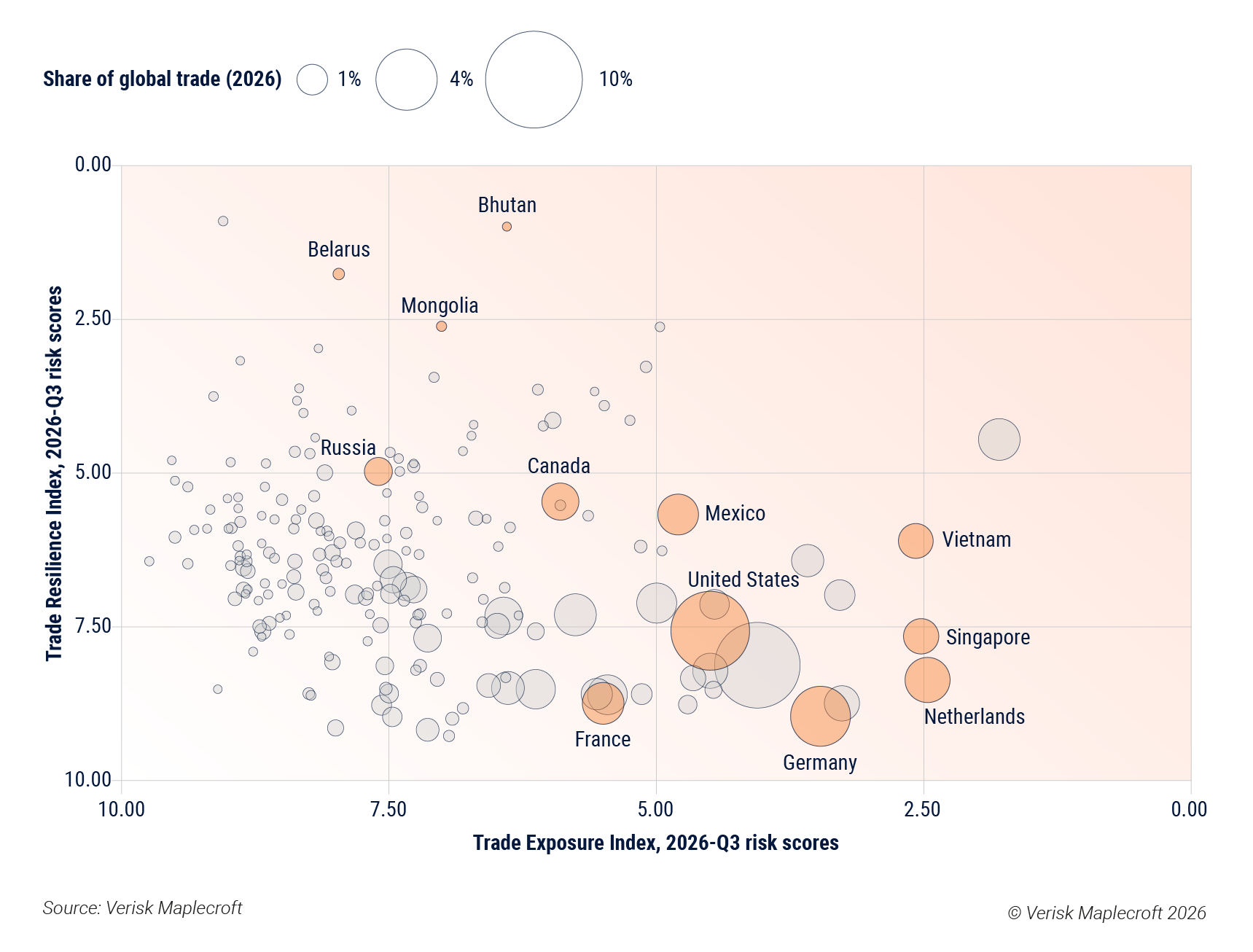
But high trade-to-GDP ratios can also amplify vulnerability. When an economy is deeply connected to the rest of the world, it becomes more exposed to external shocks beyond its control. A political crisis, a port strike or a sudden tariff shift in a distant market can trigger domestic shockwaves. To reflect this, our Trade Exposure Index measures a country’s dependence on foreign trade and its vulnerability to global market shocks by assessing goods trade-to-GDP ratios and global trade shares.
At the same time, the security of an economy’s trade flows depends not only on volume, but also on their composition. The most resilient trade profiles are defined by diversity, not only in the types of goods exchanged but also in the breadth and stability of trading partners involved. When a country’s trade is dependent on a small number of partners or reliant on unstable regimes, it is more vulnerable to disruption. This can be illuminated with our Trade Resilience Index which reveals the extent to which a country is dependent on trade and the resilience and diversity of trading partners.
Recent disruptions – COVID-19, global tariff unpredictability, conflicts and chokepoint closures such as at the Strait of Hormuz – have demonstrated these risks in practice. By using a combination of these two indices to monitor a country's trade risks and resilience, businesses can quickly understand how the trade profiles of the countries they operate in might impact their operations and supply chains in instances of trade disruption.
Incorporating Trade Resilience and Trade Exposure into business decisions
Our trade indices allow businesses to assess which countries offer more stable trade environments by comparing levels of exposure and resilience. They provide a robust, transparent assessment that can support procurement teams seeking to identify sourcing locations with more diversified and reliable trade networks to reduce the likelihood of disruption. Combined with other aspects of risk reflected in our country risk data, the trade indices can also alert risk management professionals where increasing economic risk may be rising across a company’s operational areas.
Using our trade data, businesses can compare economies and make more confident decisions around market entry and operational continuity.
For example, both Thailand and Vietnam have seen significantly increased risk across the measures of trade exposure and resilience over the last decade. Both economies have medium trade exposure risk, driven by significant – and increasing – shares of goods imports and exports compared to GDP. Mexico’s risk increase was much less significant over the same period, and Brazil’s much lower-risk trade exposure stems from its significantly larger domestic consumption, supporting growth beyond reliance on trade.
Vietnam’s higher-risk exposure score reflects the extremes to which its economic growth is reliant on goods imports and exports – making it the fourth highest-risk economy on trade resilience, after global trading hubs Hong Kong, Netherlands and Singapore.
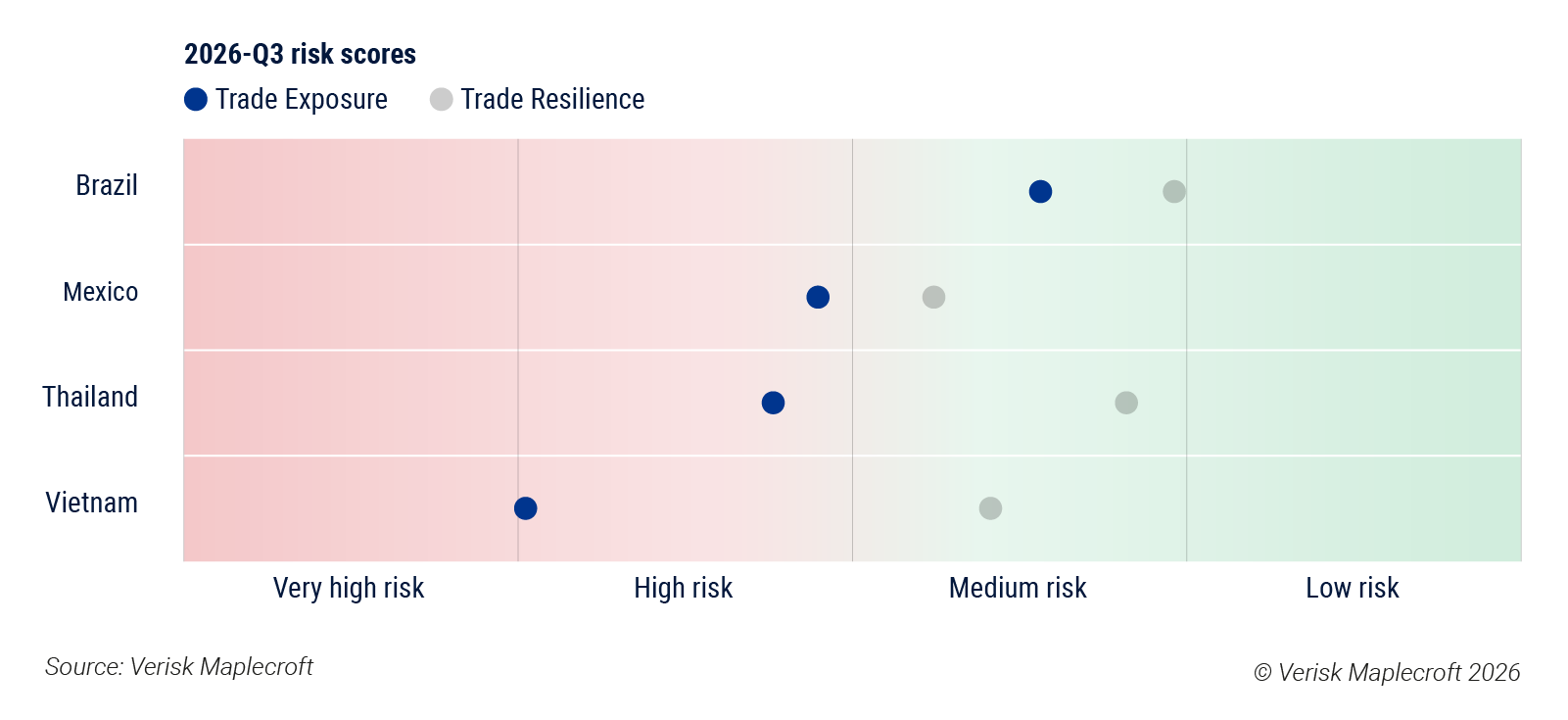
When assessing trade resilience, Thailand and Brazil both score lower risk than their regional neighbours thanks to an even balance between merchandise imports and exports, and a relatively high diversity of import partners.
On the other hand, Mexico and Vietnam’s higher-risk trade resilience scores partly stem from each country’s success as ‘connector economies’ sitting between great powers. Yet these significant increase in trade as a driver of its economic growth over the last decade makes them particularly exposed to global shocks – driving their higher-risk scores.
Don’t wait for disruption to discover your exposure
Understanding where trade concentration and dependencies create hidden vulnerability is no longer a background consideration for risk teams – it’s a critical input into sourcing, procurement, and operational decisions.
Combining global Trade Exposure and Trade Resilience indices with Verisk Maplecroft's broader Country Risk Data gives businesses the clearest possible picture of where their exposure lies, and where to act before disruption forces a decision.
Explore our Global Risk Data and find out how it can strengthen your sourcing and risk management decisions – get in touch today.