Key Takeaways
- France's riots hit around 3,000 businesses in one weekend, yet later protests were significantly less disruptive, so plans must be constantly adapted
- Impact goes beyond damage – even undamaged sites may cut hours if staff can't get in
- Spain's general strike and Berlin's protests followed France's riots within weeks, all fueled by cost-of-living anger – businesses should prepare for linked disruption potentially affecting their sites, hubs and suppliers in several countries at once
France's recent unrest affected businesses across several cities, with reported damage ranging from luxury stores to supermarkets and smaller shops. For organisations operating across Europe and beyond, recent events raise an important question. Where could future unrest disrupt their operations, employees, deliveries, and which locations should they pay more attention to with a higher priority?
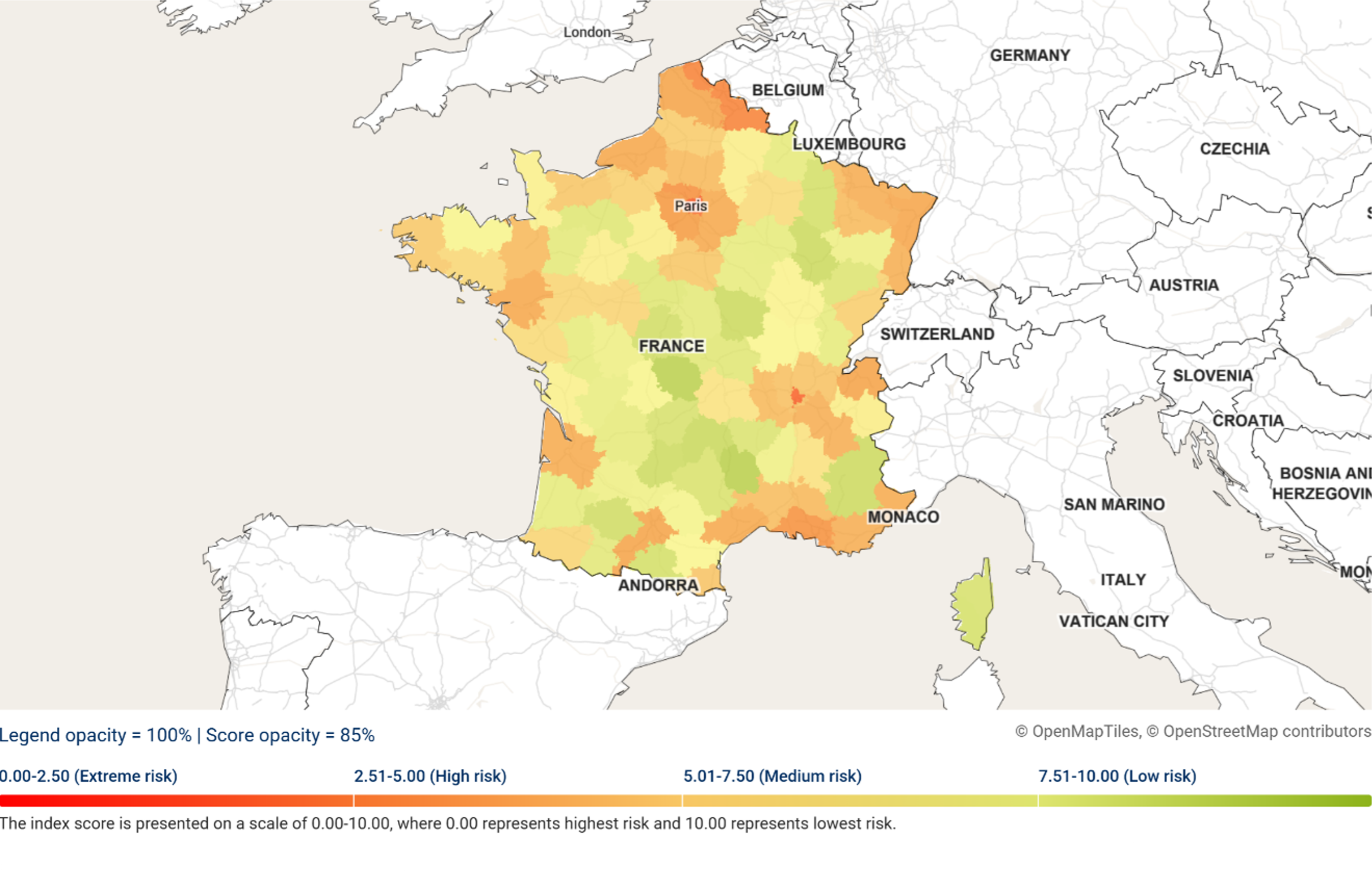
Our Civil Unrest (forecast) Index assesses civil unrest risk over the next 12 months at national and subnational levels. Figure 1 shows how that risk varied across France in our Q4 2026 data release – issued before the October unrest.
Protests in France began over school staffing and conditions, before its expansion to include concerns about the cost of living and public services. On October 17 and 18, demonstrations escalated into widespread rioting, looting, and arson. Commerce Minister Serge Papin estimated that around 3,000 businesses were affected nationwide.
Protests continued the following weekends with substantially less property damage reported. Authorities credited strengthened policing and restrictions on protest routes with helping to limit damage, while turnout also declined. For businesses, the recent unrest in France shows how conditions can change from one weekend to the next. Developing the capacity for customized planning for staffing, opening hours, and deliveries to various locations is increasingly important due to route restrictions, police enforcement, and limitations on commuting.
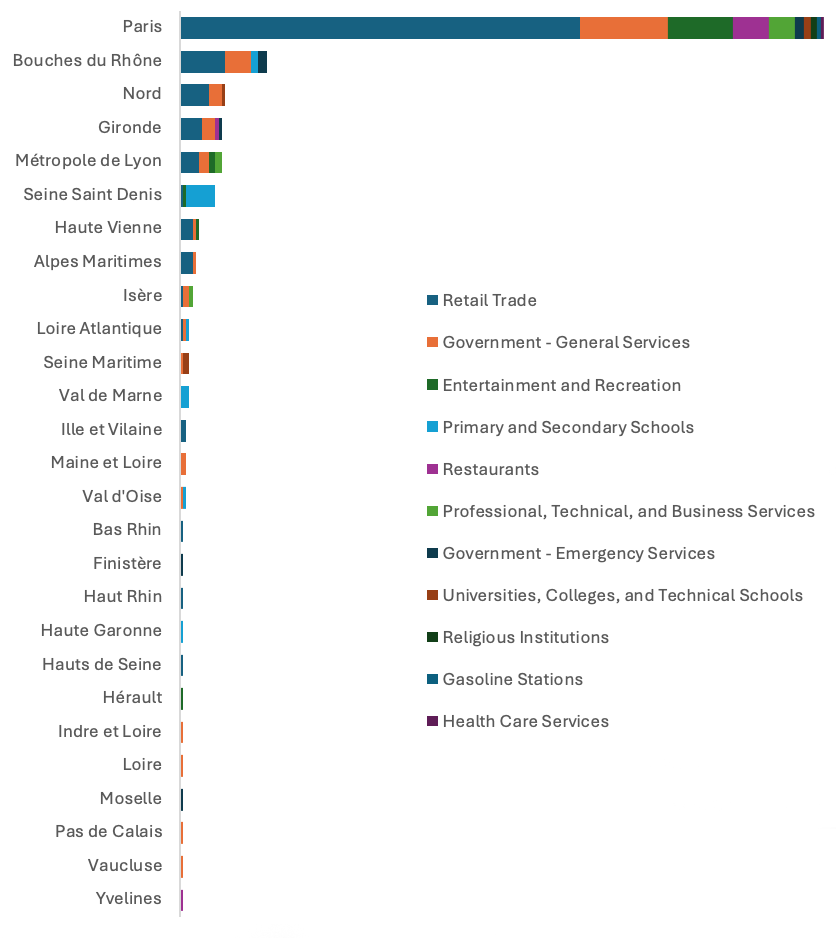
Luxury stores received much of the attention during the recent unrest in France, but news outlets also reported damage to supermarkets, smaller shops, and other businesses. Figure 2 shows the types of properties reported as affected and by the départments where they were located. The operational effects can extend beyond the sites shown – a supermarket may need to shorten its opening hours if employees cannot reach it, even when the store itself is undamaged.
Figure 2 – Occupancy classifications of properties reported as affected during the October 2026 unrest in France, by département, based on news coverage available as of November 5, 2026
Impacted properties categorized by occupancy and départments during France unrests, 2026
The disruption a company faces partially depends on where its operations are. Businesses with multiple locations in one city have a different question to answer than businesses with extended geographical coverage across different cities and countries. Our Civil Unrest (forecast) risk index provides a subnational assessment of expected civil unrest risk globally. Companies can compare the outlook that the risk index provides with the locations of their business, distribution hubs, and major suppliers to plan for disruption protocols. Figure 3 shows the European countries at highest risk of civil unrest for the next 12 months, according to our 2026-Q4 data release. France is the second-highest risk country in Europe after Germany. Outside of France, Germany, Spain, and Italy have all experienced unrest in the recent weeks.
Figure 3: Top eight highest risk countries in Europe for 2026-Q4 Civil Unrest (forecast) risk within the next 12 months
| Country | Civil Unrest (Forecast) Index Rank in Europe | Civil Unrest (Forecast) Risk Category |
|---|---|---|
| Germany | 1 | Very High |
| France | 2 | Very High |
| Spain | 3 | Very High |
| Italy | 4 | Very High |
| United Kingdom | 5 | Very High |
| Belgium | 6 | Very High |
| Netherlands | 7 | Very High |
| Greece | 8 | High |
Source: Verisk Maplecroft
Across these countries, a common driver of public discontent has been mounting frustration over rising costs and the standard of living. While unrest elsewhere has not reached the scale or intensity of violence witnessed in France, tensions remain elevated across the continent.
Spain’s first general strike in more than a decade on 11 November drew hundreds of thousands of people onto the streets, with shop windows damaged in Barcelona and clashes with the police reported in Madrid. Germany saw renewed demonstrations organized by the "Gen Z is on it" initiative in Berlin on 14 November, with dozens of people arrested.
Given the scale of the economic challenges facing Europe, further mobilisation is likely across major regional urban centers in the near term. Such gatherings do not inevitably descend into rioting or looting, but the pattern seen in recent weeks – whereby targeted demonstrations have at times been exploited by more confrontational groups – means that further damaging unrest cannot be ruled out.
National rankings can guide an initial review of which regions deserve closer attention. Within those regions, companies can compare the subnational risk with the locations of their operations from store to offices and distribution hubs. As unrest erupts, local information such as announced routes, transport changes and access restrictions can inform decisions about staffing, opening hours, and deliveries.
Recent unrest in France shows how business in several cities can face similar disruption within a short period. The scale of disruption may vary even within the same country, due to local grievances and police response. Companies with multiple locations across different cities and countries should assess if their operational resilience is ready for widespread disruption in multiple locations at once.
Our global civil unrest data can help companies identify which regions may need closer attention. Within those regions, teams can look at where their operations are concentrated and which locations other parts of the business depend on. A disruption at a distribution hub serving several cities may carry greater operational consequences than a temporary closure at an individual store.