Key Takeaways
- Europe’s 2026-27 election cycle is likely to be accompanied by disruptive protests and sabotage as the geopolitical environment remains tense
- Europe has retained its position as the highest-risk region for civil unrest globally, pointing to a long-standing build-up of grievances
- A far-right wave could slow policy adoption or contribute to operational uncertainty from frequent or unexpected legislative changes
Europe is bracing for one of its most consequential election cycles in a generation. Eight EU member states, which together account for just over half of the EU's population and about 45% of the bloc’s GDP, are set to hold key national votes by the end of 2027.
The cycle comes at a critical moment for the continent, with governments across the bloc grappling with mounting economic, fiscal and geopolitical pressures. Strained public finances, elevated energy costs and growing security threats, including a recent wave of hybrid activity, are complicating an already challenging political environment.
At the same time, many countries are still reeling from some of the most significant concurrent unrest seen in Europe for several years, with protests over living costs, cuts to public services and living standards highlighting the scale of public frustration with the status quo.
With far-right parties polling strongly in several countries – most notably in France, where Marine Le Pen is currently favourite to win the 2027 presidential election – the upcoming votes have the potential to remake the European political landscape. For businesses, the implications will extend beyond the national level, with the electoral outcomes set to shape the future direction of EU policymaking, and potentially weigh on the bloc’s ability to address its structural challenges.
Polling points to rightward shift in key economies
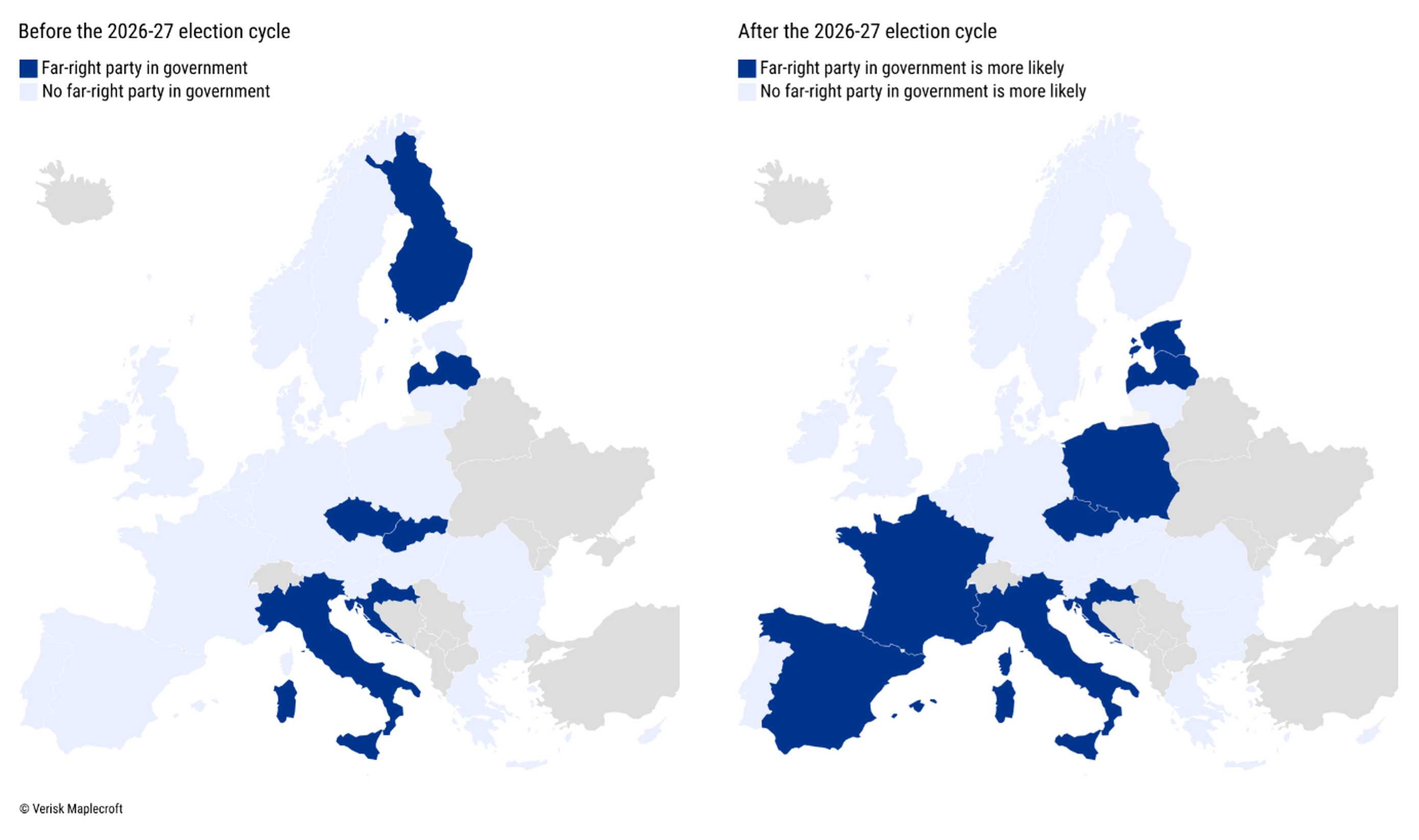
Across almost all of the countries holding elections, nationalist or far-right parties have a realistic chance of either gaining or retaining power, or entering government as a junior coalition partner – see Figure 1. The elections in Spain, France, Poland and Italy will be particularly consequential, with these countries accounting for four of the EU’s five largest member states by population. While the domestic political dynamics differ from country-to-country, growing support for hard-right parties is a common trend, raising the prospect of a broader rightward shift across the bloc.
- Spain, 29 November 2026: While Prime Minister Pedro Sánchez has bucked Europe’s broader rightward shift in recent years, notably through his stance on migration, polling suggests a power shift is likely in Spain. Despite his proven political resilience, Sánchez faces an array of challenges, including pressure over his handling of the migrant crisis in Ceuta and corruption concerns among members of his inner circle. Current polling points to a combined majority for PP and the far-right Vox, opening the door to a right-wing coalition government.
- France, 18 April – 2 May 2027: After three unsuccessful bids for the presidency, Marine Le Pen of the far-right National Rally (RN) is leading first- and second-round polling against her likely challengers. Much could change before April, but an RN presidency in France, the second-largest EU economy and one of its most influential member states, would mark a major shift in the bloc’s political landscape and shift the balance of power in a more decisively sovereigntist direction.
- Poland, October 2027: Fragmentation will contribute to a tense election campaign in Poland. Prime Minister Donald Tusk's centre-right bloc is leading comfortably in the polls. However, the combined conservative opposition is currently better placed to form the next government. A conservative government with increased weight for far-right parties is likely to make Poland less cooperative at the EU level.
- Italy, December 2027: While the gap between the right- and left-leaning blocs in Italy is narrowing, Prime Minister Giorgia Meloni remains well placed to retain power. However, the rise of Roberto Vannacci’s far-right National Future (NF) is generating pressure on the coalition’s right flank and may undermine Meloni’s moderate conservative approach going forward. Meloni is likely to adopt more hardline positions over the near term in a bid to blunt NF’s rise, and a harder-right post-election coalition with Vannacci remains a possibility.
Countries that have far-right or nationalist and populist parties in government
Election cycle coinciding with elevated unrest and security challenges
With several of Europe's largest economies gearing up for elections, the risk of political instability is set to increase. Not only is the election cycle unfolding against a backdrop of widespread social discontent, but also in a tense geopolitical environment. These factors threaten to expose businesses in Europe to a wide array of operational challenges and could require higher spending on security, business continuity and resilience planning, as well as crisis management.
Europe has retained its position as the highest-risk region globally on our Civil Unrest (forecast) Index (CUI) throughout 2026. Recent riots, protests and strike activity have highlighted the scale of the challenge across the continent, with voters increasingly taking to the streets to express their frustrations with living costs and cuts to social spending and public services. Historically, our data has shown that elections in democratic societies are relatively poor predictors of unrest, as voters tend to channel their anger through the ballot box. However, given the scale of public discontent with the political status quo, there is no guarantee that this pattern holds. All eight countries heading to the polls rank as high or extreme risk on the CUI, with France, Spain and Italy among the ten highest-risk countries globally.
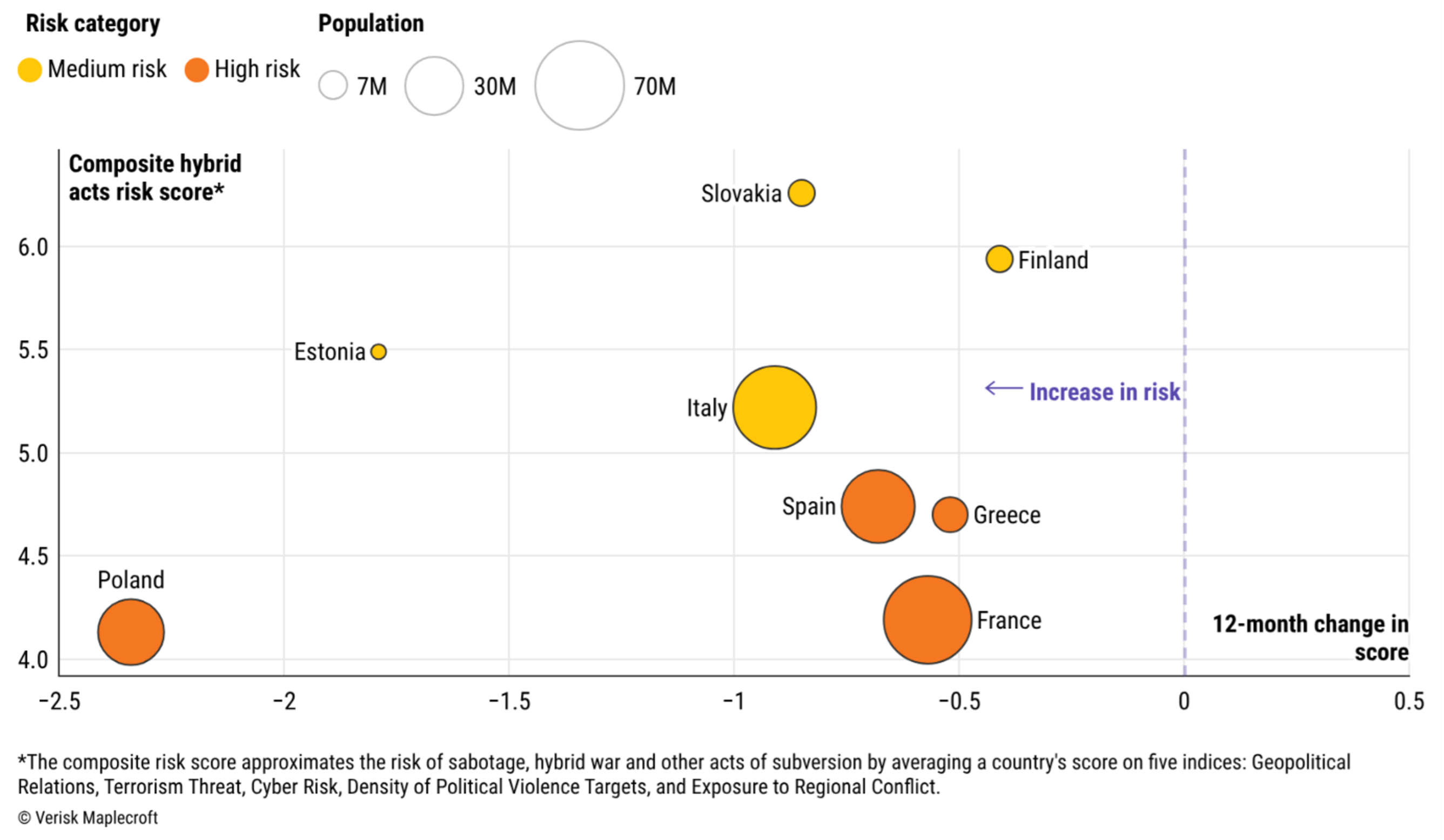
Sabotage and other acts of subversion arising from heightened geopolitical tensions are highly likely across the eight voting countries. While we do not expect such hostile activities to target the electoral process directly, foreign governments, terrorist groups and opportunist local actors are likely to exploit social tensions and seek to test logistical and digital vulnerabilities, undermining government response mechanisms. Businesses may need to consider the risk of disruption from sabotage along their entire supply chain and flag potential weak spots (such as links to defence or energy) for additional monitoring.
Composite risk score measuring approximate risk of sabotage, hybrid war and other acts of subversion, 2026-Q3
Right-wing tilt raises policy and execution risk for businesses operating in the EU
More broadly, a populist wave in the 2026-27 election cycle would likely carry significant implications for policymaking at the EU level moving forward. Member states are already struggling to agree on major initiatives, and a more right-leaning European Council would likely make it harder to reach consensus on issues such as common borrowing, green energy initiatives and EU enlargement. Further support for Ukraine, efforts to strengthen European defence cooperation and initiatives around EU integration could also face greater resistance.
Regardless of the election outcomes in the next year, we expect the EU to remain broadly divided in its response to major challenges. Reforms are likely to be piecemeal, while major policies will move slowly through the institutions. Government focus will shift further towards unwinding some unpopular EU regulations, which is likely to create more policy uncertainty for businesses. While deregulation in general could be seen as positive for growth and business activity, the approach so far has been inconsistent and limited in scope, creating a more complex operating environment, raising compliance costs and opening the door to fiercer external competition.
Against this backdrop, it will become increasingly incumbent upon firms to build flexibility into compliance, investment and market-entry plans, and stress-test strategies against scenarios in which key EU initiatives stall or are reversed.