Key Takeaways
- Marine or 'blue' risks are pervasive across government debt portfolios
- Coastlines that are highly exposed to sea level rise face potentially material credit risk impacts
- Nature-based solutions provide cost-effective coastal protection
Marine ecosystems and the ‘blue’ economies they support are of increasing interest to sustainable investors. Seychelles, Fiji and Indonesia have issued small labelled ‘blue’ bonds in the past decade, the largest of them just USD150 million. Thailand also plans to issue a debut blue bond to finance sustainable ocean-based development.
However, despite the small size of this labelled market, ‘blue’ risks are pervasive across government debt portfolios. Identifying and managing them will be increasingly critical to effective credit risk management, as well as expected as part of climate and/or nature-related scenario analysis; and potentially unlock further thematic or impact investment opportunities.
Marine and coastal biodiversity for greater resilience to sea level rise
As climate change progresses, countries will need to become more resilient to the compounding effect of sea level rise on natural hazards and environmental impacts: chronic and extreme flooding, as a result of storm surges or in conjunction with runoff or riverine flooding, erosion, inundation, and salination of aquifers and farmland.
In theory, sustainably managed coastlines should be set to play a crucial role in helping them do that. The Kunming-Montreal Global Biodiversity Framework, adopted in 2022, requires that countries place at least 30% of their terrestrial, inland water, coastal and marine areas under sustainable protection and management (along with 30% of degraded ecosystems in these areas) by 2030.
International organisations have long promoted nature-based solutions as key to coastal protection alongside artificial defences, alongside positive impacts on biodiversity and carbon sequestration. Reefs, marshes, dunes, seagrasses and mangrove swamps can buffer waves and storm surges, and stabilise and even accumulate sediments, mitigating extreme events and reducing erosion, degradation and loss of land.
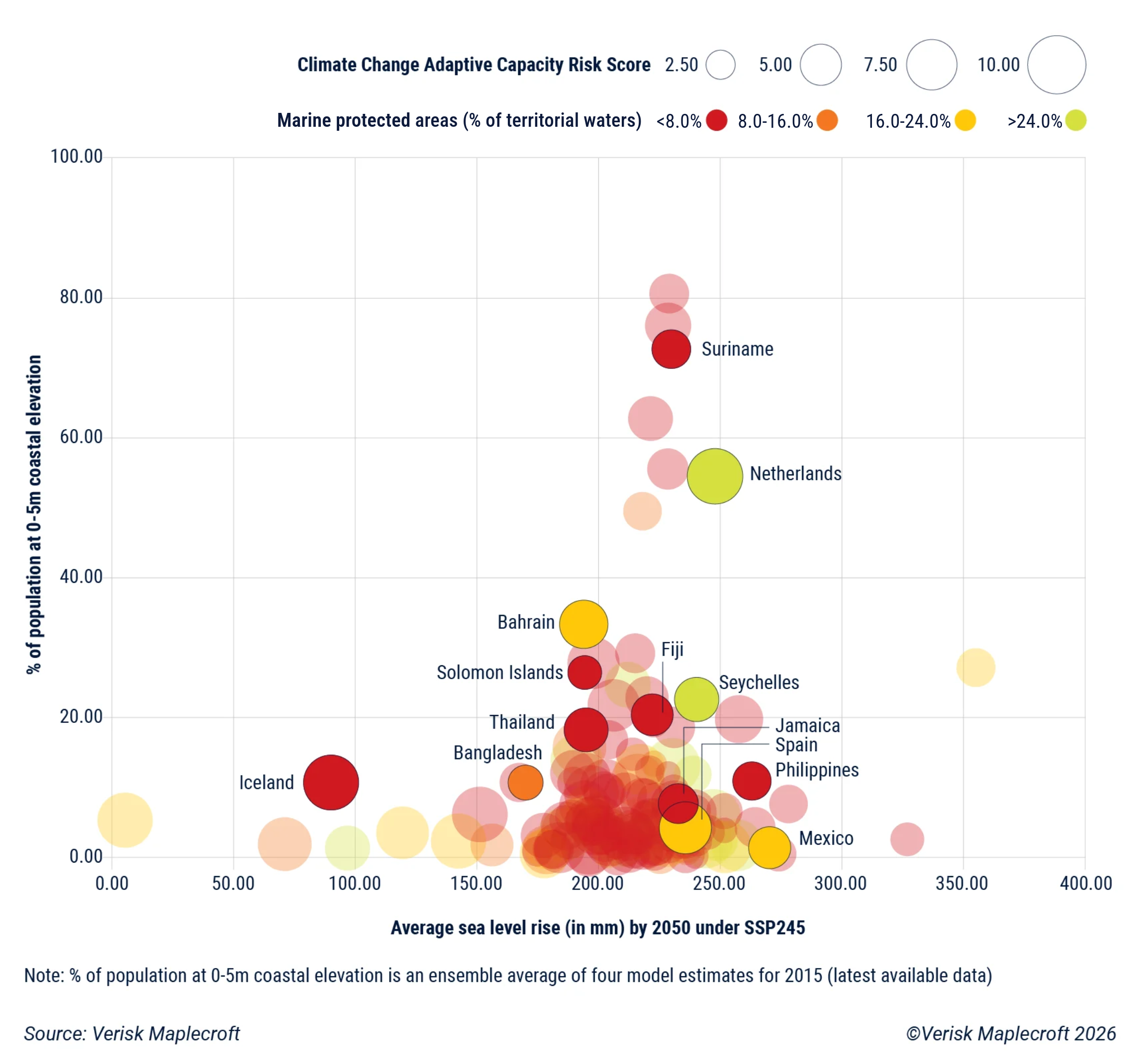
However, as Figure 1 shows, strong protection of marine territorial waters is still the exception, not the rule, for many countries – including a range of bond issuers labelled here – projected to face significant sea level rise and with high proportions of their national populations living in coastal areas less than 5m above sea level. Most also have poor levels of overall adaptive capacity in relation to climate change. While the marine protection data does not relate to coastal ecosystems specifically, it is very likely that coastal protections are even worse insofar as governments have tended to privilege the protection of offshore areas under less resource pressure and fewer political constraints than their coastal equivalents.
All issuers with heavily populated – in many cases economically crucial and urbanised – coastlines that are highly exposed to sea level rise face potentially material credit risk impacts, including through the fiscal channel when governments proactively improve coastal defences, or support relocation or other adaptations. Investors engaging with issuers may be able to present biodiversity protections, and specific nature-based solutions, as complementary and often cost-effective mitigations.
Ocean-dependent economies at high risk from coastal pollution
A subset of countries – 35 as of 2024, according to UNCTAD – also derive 10% or more of their total goods and service exports from industries that derive value from their coasts and territorial waters and thus face additional economic risks if these waters are significantly degraded. As shown in Figure 2, most of these countries are categorised as high or very high-risk on their overall environmental regulatory frameworks, on water pollution, or plastic pollution. All have issued local currency or hard currency debt, and most are in standard debt benchmarks, meaning they are integral to many portfolios.
For many of these countries, moreover, coastal tourism is a key driver of foreign currency inflows, heightening the potential economic implications of any revenue losses.
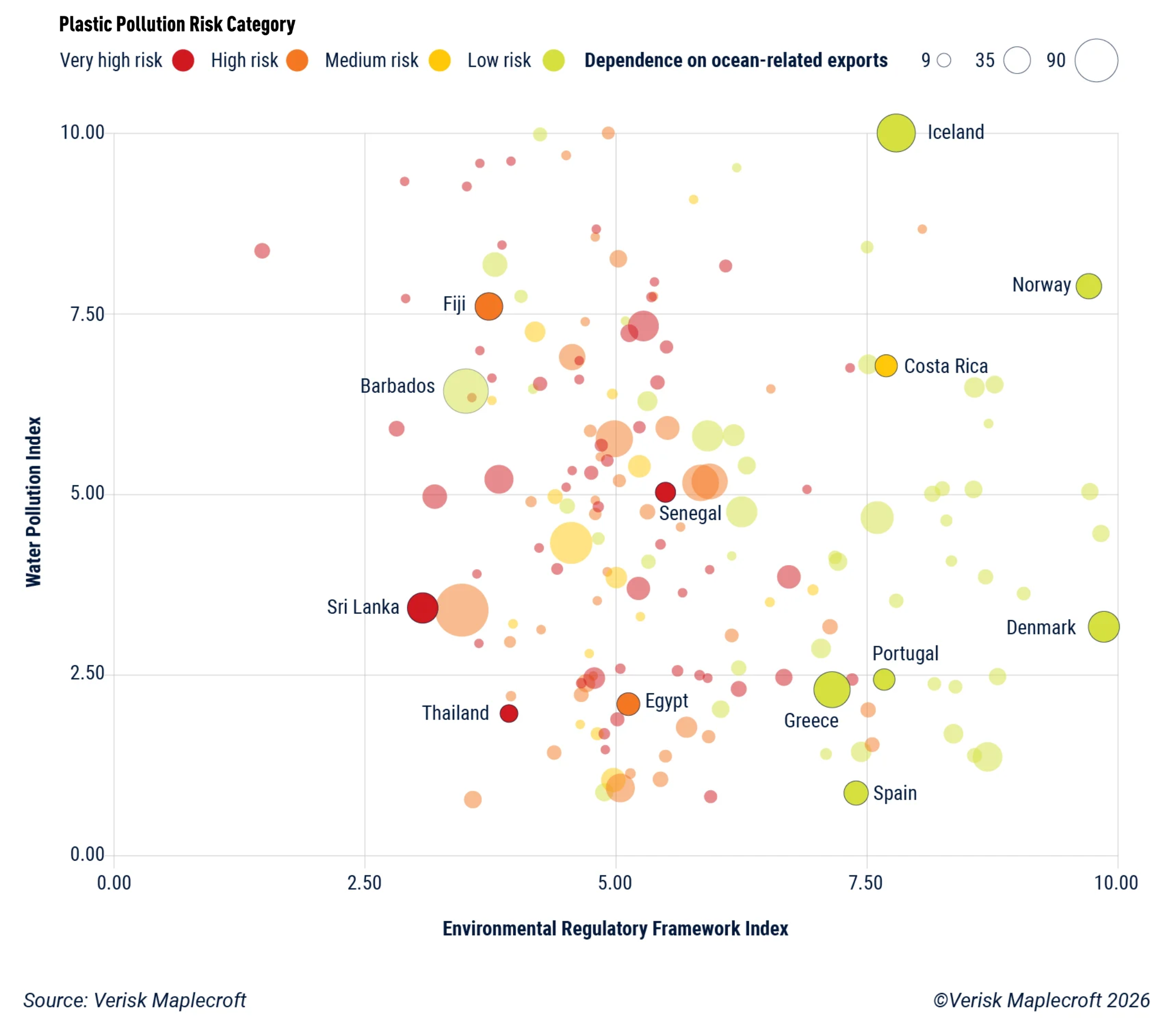
Enabled by weak regulations, both plastic pollution and water pollution severely degrade coastal environments. The plastic pollution data, drawn from our Sustainable Waste Management Index, measures open burning and the discarding of plastic debris – much of which ends up in watercourses and ultimately the sea, both harming wildlife and destroying the appeal of holiday destinations. As the data in Figure 2 shows, it is a particular challenge for low income and lower-middle income issuers such as Sri Lanka and Senegal.
Additionally, the data from our Water Pollution Index, which measures nine different drivers of pollution affecting rivers and coasts, suggests that this is an even more significant threat. Among the ocean-dependent economies that perform poorly on this metric are multiple developed markets, including southern European tourist destinations. Sewage, agricultural run-off, and industrial chemicals can cause eutrophication and oxygen-depleted ‘dead zones’ in sensitive coastal ecosystems. Terrestrial pollution can also damage fisheries, particularly shellfish, which bioaccumulate dangerous contaminants and pathogens.
Viewed in conjunction as in Figure 2, our data on risk drivers and outcomes for coastal pollution can contribute to managers’ analysis of ocean-dependent economies’ vulnerability to short-term or long-term disruptions to growth or the balance of payments; as well as help to prioritise and shape engagement with their governments.
From blue risk exposure to resilience
The small ‘blue’ labelled debt market should continue to provide opportunities to investors with a mandate to directly finance improvements in coastal resilience, biodiversity and waste management.
Beyond this, however, our data shows that sustainable management of coastal biodiversity, including as part of managing exposure to rising sea levels, are structural risks that cut across emerging-market and some developed-market portfolios alike.
Managers will benefit from incorporating these considerations into long-term climate scenario analysis and any wider climate- and nature-oriented engagement programmes with issuers. Moreover, marine-related risks should also feature in portfolio risk monitoring and security selection. Long-term potential economic impacts can rapidly become short-term, especially for countries that partly rely on currency inflows from tourism and can suffer material consequences from a single bad season.