Key Takeaways
- More tropical forest moves into high risk wildfire zones without emissions abatement, with major exporters facing significant increases
- Fires threaten soy and palm oil supply chains, worsen air quality and raise scrutiny for companies sourcing from the tropics
- With nature loss increasingly treated as a systemic risk, companies need to address supply chain risk
Over 75% of the world’s tropical forests, an area twice the size of Australia, face elevated threats from wildfires if global emissions stay on an unstable path – according to new analysis of our Wildfire Hazard Index. This comes after a record year for tropical forest loss from fires in 2024, with 2025 marking the fourth-worst year this century. With a “super” El Niño bringing hotter, drier conditions to tropical regions in 2026 and 2027, including a delay to the Amazon rainy season, the risk of severe fires is still rising.
Our data reveals mounting pressure on some of the planet’s most important ecosystems. Just 10 countries hold around 60% of the world’s tropical forests, including Brazil, Colombia and Peru in the Amazon basin, as well as DR Congo, Angola and India. For business and financial organisations, these are important emerging markets that are significant constituents in leading global benchmark indices – and important supply hubs for critical minerals and agricultural products. Tracking wildfire risk across both countries and commodities should be forecasting necessity for businesses that stand to be affected.
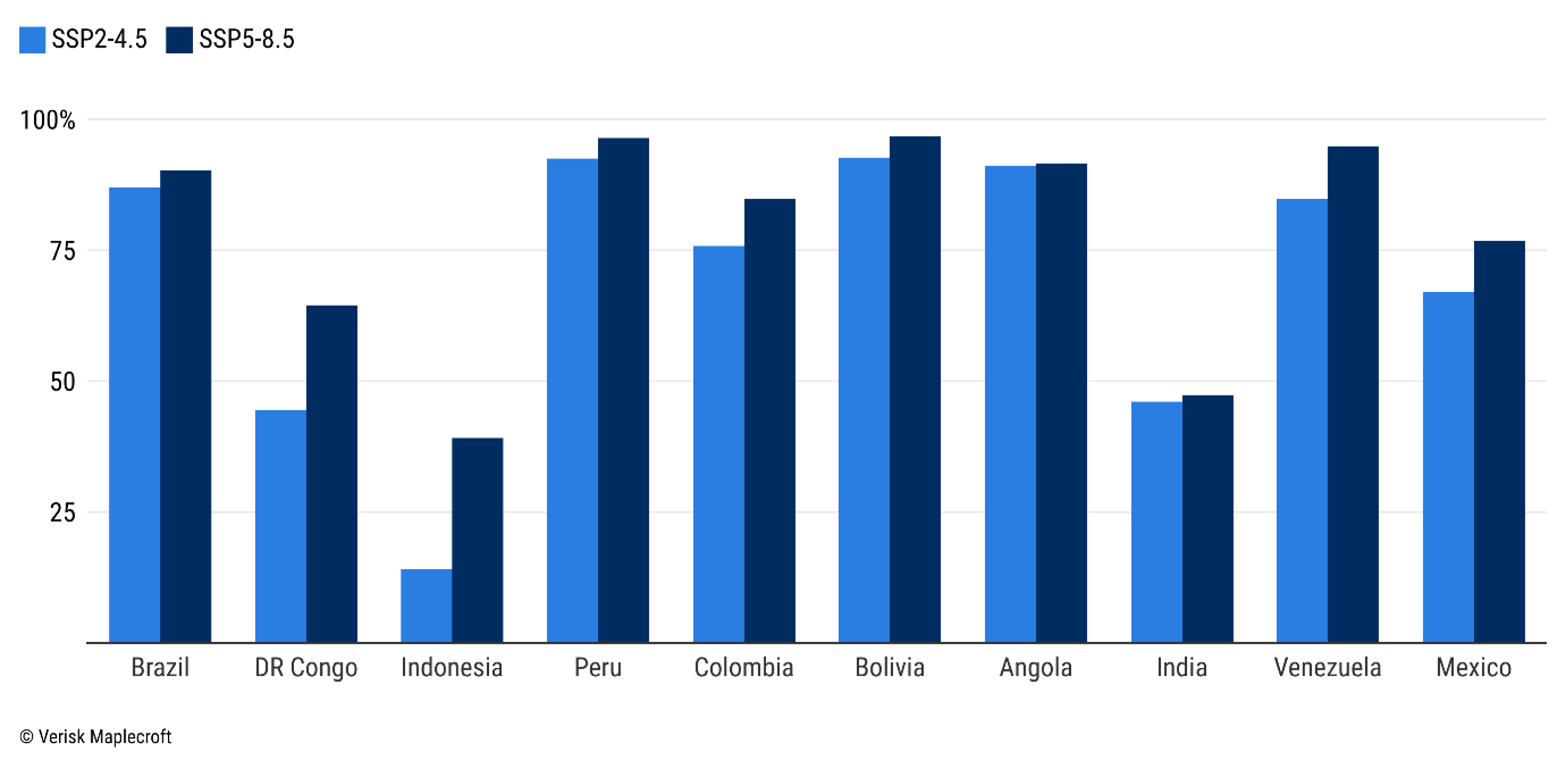
As of 2026, 70% of tropical forest in these 10 countries is at high or very high risk according to our Wildfire Hazard Index. Should emissions accelerate, that figure increases to 79% by 2050, representing an extra million square kilometres of tropical forest at higher risk compared to today – an area roughly the size of France, Germany and the UK combined – with Brazil, Venezuela, Peru and Mexico forecast to see the sharpest rises in risk. Across the globe, 75% of forests are predicted to be at risk in 2050, compared to 70% today.
Tropical forests under growing fire pressure
Fire has historically been rare in many wet tropical forests. High humidity usually protects these ecosystems, but hotter, drier and windier conditions are eroding that natural resilience. As forests dry out, fires can spread faster and burn longer. In drier tropical forests, where fire is already more common, climate change is expected to intensify both the frequency and severity of fire events.
Some countries will be more affected than others if global heating increases by more than currently expected, under different Shared Socioeconomic Pathways (SSPs) as defined by the IPCC. Under SSP2-4.5, global heating is limited to 2.7°C by 2100, similar to the world’s current trajectory; this results in significantly less wildfire risk to tropical forests in Indonesia and DR Congo, as well as Colombia, Venezuela, and Brazil, compared to an SSP5-8.5 scenario where warming rises above 4°C.
Cascading consequences of tropical forest fires
Tropical forests help regulate the global climate, store vast amounts of carbon, support biodiversity, and underpin the water and rainfall systems that agriculture and communities depend on. When they burn, the damage extends beyond the immediate fire zone: forests are lost, emissions rise, air quality worsens, and already fragile landscapes become even more vulnerable to future degradation.
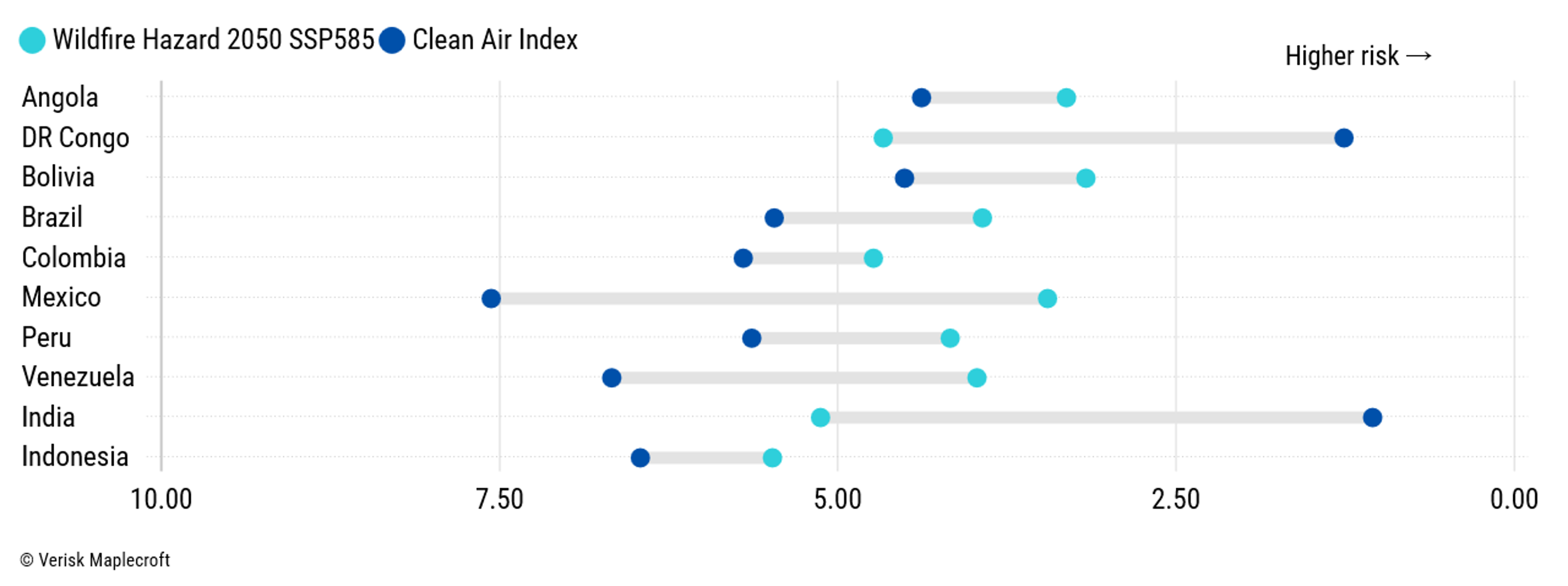
Fires in major agricultural regions such as Brazil, Indonesia and Bolivia can damage farms near forested areas, degrade soils, disrupt transport routes and add pressure to supplies of commodities such as soy and palm oil. They also worsen air pollution endangering the health of populations and workers. Of the 10 countries with the largest areas of tropical forests in high and very high-risk areas for wildfire in 2050, only Mexico has average air pollution levels considered safe by the WHO, according to its low risk score on our Clean Air Index.
Companies need to consider how fires threaten livelihoods and add to scrutiny of land-use practices in areas covered by tightening deforestation rules, such as the EU’s Deforestation Regulation (EUDR). At the same time, every large fire season increases the loss of natural capital and adds further emissions to a warming atmosphere.
How to take a systemic risk-management approach to tropical forests
Companies are taking steps to improve the resilience of their supply chains to tropical wildfires.
- Eliminating fire-linked deforestation: Mapping supply chains beyond Tier 1 suppliers allows for data-led risk assessments, monitoring, and supplier engagement around “no burning” policies for high-risk commodities such as palm oil, soy, beef, and cocoa, which together account for over two-thirds of global deforestation.
- Cross collaboration: Working with governments, NGO, and communities to invest in forest protection and sustainable land-use planning
- Building supply chain resilience: Using frameworks such as that established by the Taskforce for Nature-related Financial Disclosures (TNFD) to locate wildfire exposure and assess dependencies and impacts, before integrating fire risk into strategy and disclosures. Ultimately, a sound data-led approach illuminates decisions around contingency planning, the value of funding conservation or restoration projects, or even potentially pivoting away from high-risk sourcing locations.
Wildfire threats to tropical forests must also be understood in systemic macroeconomic and financial terms. The Network for Greening the Financial System (NGFS) has warned that the loss of these critical natural systems, as anchors and stabilisers of the global macroeconomy, could generate cascading economic shocks larger than the 2008 global financial crisis. Brazil’s export-oriented agriculture sector is worth 6% of GDP and the tropical forests of South America, along with those of Southeast Asia, are critical to global food, energy and critical minerals security.
Increasingly, leading financial regulators and central banks such as the ECB and the BOE are taking the view that these systems are simply ‘too big to fail’. As such, international banks, global institutional investors such as pension and sovereign wealth funds, insurers and other financial actors may ultimately see legal and fiduciary duties evolve in such a way that they are legally required to cease their contribution to climate and nature-related financial risks, and instead finance the reduction of these risks.
The logical direction of travel in the medium term for international capital providers seems clear – the protection and preservation of critical natural systems will be a fiduciary obligation. This year’s El Niño conditions bring into sharp focus the need to limit emissions and reduce pressure on forests, or see wildfire risk in some of the world’s most important ecosystems rise ever higher.