Key Takeaways
- Our Country Risk Data has revealed the markets offering new routes to supply chain resilience in Southeast Asia and Latin America
- Thailand, Philippines, Argentina, Uruguay and Chile provide distinct opportunities for the next phase of supply chain diversification
- Data-led approaches, combined with sectoral advantages and the impact of new trade agreements, can turn this opportunity into logistical resilience and competitive advantage
Geopolitical risk has moved supply chain diversification from efficiency exercise to boardroom priority. Vietnam, Malaysia, Mexico and Brazil have been the main beneficiaries of declining direct trade between China and the US, combining large trade volumes with strong merchandise export growth. Their success variously combines geostrategic advantages with strengthening industrial ecosystems and scale – but according to our data, risks to multinational supply chains in all of these jurisdictions are increasing.
For businesses looking beyond established sourcing hubs, our Country Risk Data and expert insight have identified a second wave of diversification markets which balance viable current risk levels with improving risk trajectories, led in Southeast Asia by Thailand and the Philippines, and in Latin America by Argentina, Chile and other Southern Cone countries. Relative to the established hubs, these “rising stars” offer different mixes of sector capability, market openness, regulatory strengths, and labour-risk trajectories for organisations looking to realign their supply chains.
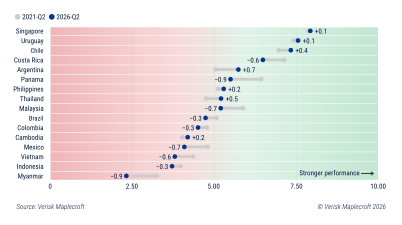
Figure 1: Rising stars show stronger risk-adjusted trajectories across openness, regulation and labour indicators
Key manufacturing economies in Southeast Asia and Latin America, 2026-Q2 scores and change since 2021-Q2
Rising stars emerging as targeted diversification options
To identify where supply-chain decision makers should look next, we benchmarked key manufacturing economies in Southeast Asia and Latin America against market openness, regulatory strength and labour rights – structural, slow-moving factors that are critical to manufacturing supply chains.
Southeast Asia remains the natural starting point: it has been the clearest beneficiary of supplychain reconfiguration at scale. Latin America is also in focus here, as Western-led efforts to re-anchor critical supply chains regionally sharpen its business case.
Having built a commanding position, economies that have already benefited from global manufacturing supply chain diversification – Vietnam, Malaysia, Singapore, Mexico and Brazil – will remain central. But in a world shaped by geopolitical risk, while the core considerations of cost and efficiency still matter, they are no longer sufficient to guarantee success.
Thailand and Philippines offer contrasting opportunities in Southeast Asia
Vietnam and Malaysia, Southeast Asia’s leading diversification hubs, have both deteriorated across our measures of market openness, regulatory quality and labour rights in the last five years, while the region’s largest economy, Indonesia, has regressed on market openness due to rising resource nationalism. Against these sliding scores, the region’s top two improvers, Thailand and the Philippines stand out. The Hormuz crisis has created near-term headwinds for both countries, but our data indicates that procurement teams willing to take a longer-term view will find these markets worth their attention.
Thailand showed the second-highest improvement overall, driven by the largest upgrade on our market openness pillar across the economies analysed, as well as significant regulatory improvement. These factors are reflected in the country’s strength in select manufacturing industries.
Thailand is Southeast Asia’s leading auto manufacturer, with the sector contributing $30 billion USD in exports last year, over 10% of GDP. Key players are expanding EV and hybrid component manufacturing in response to shifting demand, highlighting a key supply chain opportunity as market openness and regulatory quality trend upwards. Thailand’s electronics sector is also surging as AI investment expands. Despite an aging workforce and relatively higher-cost labour (stemming in part from better labour rights performance than many of its neighbours) Thailand is well-positioned to host higher-value supply chain links, with growing strength in precision manufacturing, selective automation and digitalisation.
The Philippines performs second-best across the Southeast Asian economies analysed due to significant improvement on our market openness pillar. Despite lower infrastructure quality and governance challenges, including recent corruption scandals, the Philippines shows notable opportunities in sectors like electronics, auto parts and food manufacturing.
Higher-value manufacturing capabilities are being developed, and most distinctively, the Philippines’ competitive labour costs are paired with one of the region’s best risk scores on our labour rights pillar, despite some deterioration. The country’s large, young, and English-speaking population supports its leading role in outsourcing, a $35 billion USD/year industry, which has the potential to unlock industrial services co-benefits.
Latin America’s two-track supply-chain opening takes shape
Latin America still trails Southeast Asia as a scaled manufacturing platform, but Western efforts to reduce exposure to China are creating new supply-chain contenders. The opportunity is uneven: the Southern Cone is seeing an improving risk environment; Central America still matters, but more selectively.
In the Southern Cone, Argentina is emerging as a leading contender. Despite its medium-risk profile, Argentina shows the strongest overall improvement among the countries assessed, with gains across market openness and regulatory strength. Together, the United States-Argentina Agreement on Reciprocal Trade and Investment and the EU-Mercosur trade agreement are poised to drive a strategic shift across critical minerals, energy and industrial exports.
Uruguay offers the region’s strongest risk-adjusted operating profile, with Latin America’s best overall score thanks to strong market openness, low regulatory risk and improving labour-rights performance. Sound trade relations with China, the EU and the US give that profile practical force, turning agrifood, beef, dairy and pulp access into a test of readiness, customs reliability and logistics capacity.
Chile is the lower-risk Pacific-side play, combining an improving overall trajectory, driven by market openness and improving labour-rights performance, despite a weaker regulatory trend. Its critical minerals base and dense trade-agreement network make it extremely relevant. However, US-China competition requires Chile to carefully balance its geopolitical alignment, while fragmented domestic politics keep permitting reform and security policy exposed to execution risk.
In stark opposition to the Southern Cone, Central America’s risk trajectory is trending in the other direction, as other countries such as Costa Rica and Panama still perform comparatively well but are seeing deterioration in key risk indicators – as shown in Figure 2.
Figure 2: Rising stars seeing decreases in risk when compared to regional peers since 2021
| Country | Overall risk | Trend Since 2021 | Market Openness | Trend Since 2021 | Regulatory Strengths | Trend Since 2021 | Labour Rights | Trend Since 2021 |
|---|---|---|---|---|---|---|---|---|
| Argentina | Medium risk | ↑ Increase in risk | Medium risk | ↑ Increase in risk | Medium risk | ↑ Increase in risk | Medium risk | ↑ Increase in risk |
| Thailand | Medium risk | ↑ Increase in risk | Medium risk | ↑ Increase in risk | Medium risk | ↑ Increase in risk | High risk | - No change in risk |
| Chile | Medium risk | ↑ Increase in risk | Low risk | ↑ Increase in risk | Medium risk | ↓ Decrease in risk | Medium risk | ↑ Increase in risk |
| Philippines | Medium risk | ↑ Increase in risk | Medium risk | ↑ Increase in risk | Medium risk | - No change in risk | High risk | ↓ Decrease in risk |
| Cambodia | High risk | ↑ Increase in risk | Medium risk | ↑ Increase in risk | High risk | ↑ Increase in risk | High risk | ↑ Increase in risk |
| Uruguay | Low risk | ↑ Increase in risk | Low risk | - No change in risk | Low risk | ↑ Increase in risk | Medium risk | ↓ Decrease in risk |
| Singapore | Low risk | ↑ Increase in risk | Low risk | - No change in risk | Low risk | ↓ Decrease in risk | Medium risk | ↓ Decrease in risk |
| Indonesia | High risk | ↓ Decrease in risk | High risk | ↓ Decrease in risk | High risk | ↑ Increase in risk | High risk | - No change in risk |
| Colombia | High risk | ↓ Decrease in risk | High risk | ↓ Decrease in risk | Medium risk | - No change in risk | High risk | ↑ Increase in risk |
| Brazil | High risk | ↓ Decrease in risk | High risk | ↓ Decrease in risk | Medium risk | ↓ Decrease in risk | High risk | ↑ Increase in risk |
| Vietnam | High risk | ↓ Decrease in risk | High risk | ↓ Decrease in risk | High risk | ↓ Decrease in risk | High risk | ↓ Decrease in risk |
| Costa Rica | Medium risk | ↓ Decrease in risk | Medium risk | ↓ Decrease in risk | Medium risk | ↓ Decrease in risk | Medium risk | ↓ Decrease in risk |
| Malaysia | Medium risk | ↓ Decrease in risk | Medium risk | ↓ Decrease in risk | Medium risk | ↓ Decrease in risk | High risk | ↓ Decrease in risk |
| Mexico | High risk | ↓ Decrease in risk | High risk | ↓ Decrease in risk | High risk | ↓ Decrease in risk | High risk | ↑ Increase in risk |
| Myanmar | Very high risk | ↓ Decrease in risk | High risk | ↓ Decrease in risk | High risk | ↓ Decrease in risk | Very high risk | ↓ Decrease in risk |
| Panama | Medium risk | ↓ Decrease in risk | Medium risk | ↓ Decrease in risk | Medium risk | ↓ Decrease in risk | High risk | - No change in risk |
Source: Verisk Maplecroft
© Verisk Maplecroft 2026
What does it mean for supply chain decision makers?
The next supply chain advantage will come from matching diversification ambition with risk-adjusted execution. Thailand, the Philippines, Argentina, and Chile do not offer simple interchangeable alternatives to today’s top connector economies. Rather, they offer specific plays across sectors ranging from autos, electronics and precision manufacturing, to critical minerals and agribusiness.
The businesses that move first – screening these markets now, building supplier relationships before demand spikes, and stress-testing entry strategies against external risk data – will find themselves better-positioned to act when faced with disruptive geopolitical realignment, trade restrictions, or conflict outbreaks.