Companies and investors face growing expectations to understand and manage risks linked to conflict-affected and high-risk areas (CAHRA). Established more than a decade ago within the OECD’s due diligence guidance for responsible mineral supply chains, the use of the CAHRA concept has since broadened to inform a wide set of regulatory requirements, market norms and stakeholder expectations. Today, it underpins responsible sourcing strategies across multiple sectors, informs responsible sales practices, and is increasingly relevant for investors looking to assess their exposure to conflict, governance and human rights risks.
At the same time, conflict itself is affecting a growing share of global territory. Data from our Conflict Intensity Index shows that 6.1% of territory across the world’s six permanently inhabited continents is impacted by armed fighting, up from 2.6% five years ago. Together, the expansion of regulatory and stakeholder expectations and the geographic spread of conflict are sharpening the need for global organisations to monitor how their operations and investments interact with global conflict dynamics.
But doing so remains challenging, as there is no definitive or official list of high-risk jurisdictions. For example, the European Commission funds the publication of an indicative CAHRA list in support of its Conflict Minerals Regulation, but this only covers a narrow set of countries associated with the production of four minerals (gold, tin, tungsten and tantalum). Companies and investors therefore often struggle to establish a consistent method for identifying and assessing their exposure to CAHRA.
Focus box
How does the OECD define conflict-affected and high-risk areas?
Conflict-affected and high-risk areas are identified by the presence of armed conflict, widespread violence or other risks of harm to people. Armed conflict may take a variety of forms, such as a conflict of international or non-international character, which may involve two or more states, or may consist of wars of liberation, or insurgencies, civil wars, etc. High-risk areas may include areas of political instability or repression, institutional weakness, insecurity, collapse of civil infrastructure and widespread violence. Such areas are often characterised by widespread human rights abuses and violations of national or international law.
OECD Due Diligence Guidance for Responsible Supply Chains
To help close that gap, we have mapped our suite of Country Risk Data against the OECD’s CAHRA definition, allowing organisations to identify, assess and monitor CAHRA with greater precision. The configuration can be utilised for various use cases, from supporting responsible sourcing and sales to assessing portfolio-level exposure to CAHRA-related risks.
Country Risk Data mapped against CAHRA
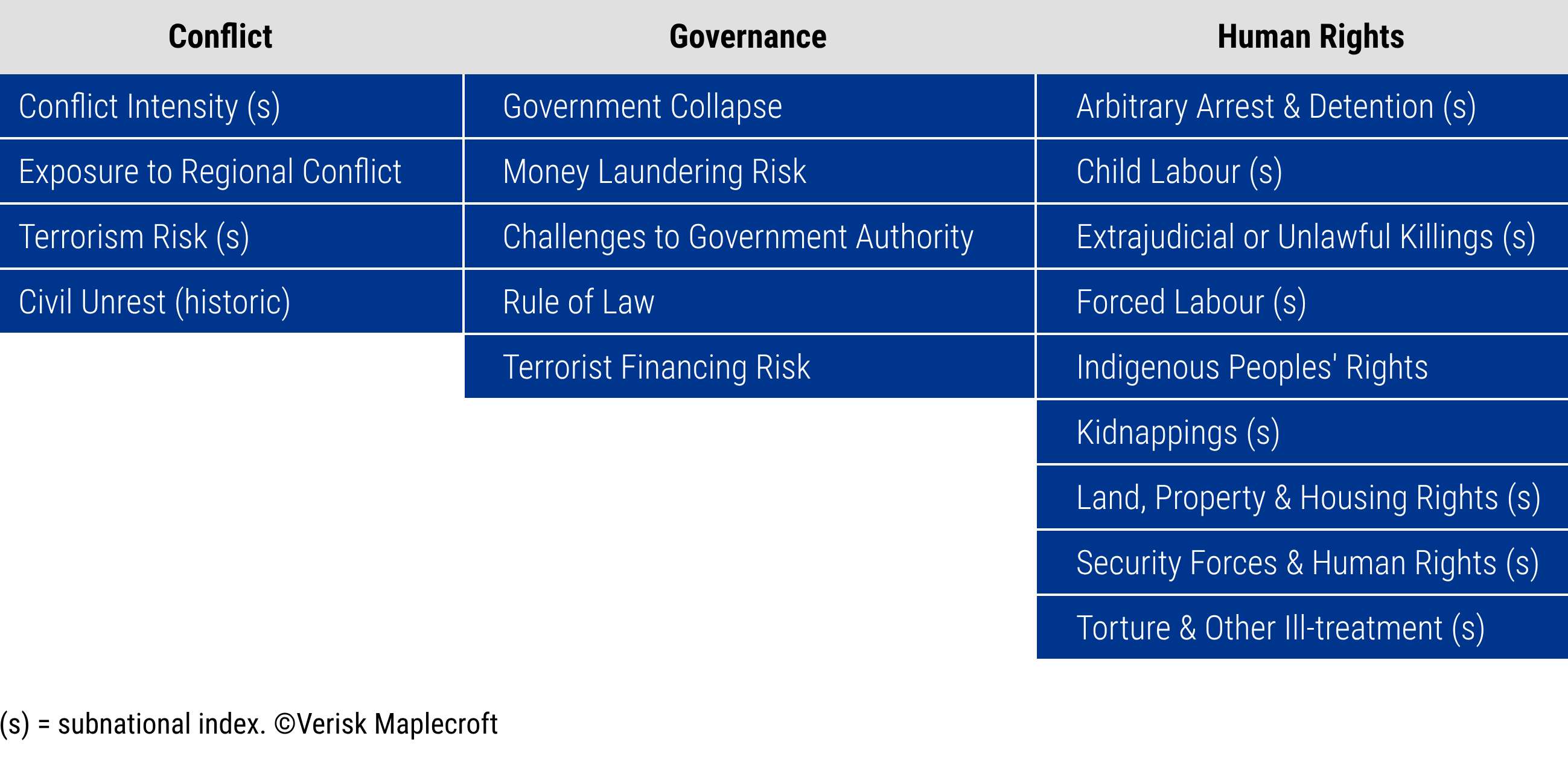
The CAHRA data configuration combines 18 of our proprietary risk indices and is broken down across three pillars: conflict, governance and human rights (see table below). Ten of the risk indices are subnational, offering the granularity needed to distinguish risks both between countries and higher risk zones within them. The configuration tracks risk in 198 countries and is updated quarterly, enabling users to monitor their evolving risk exposures as conditions shift on the ground.
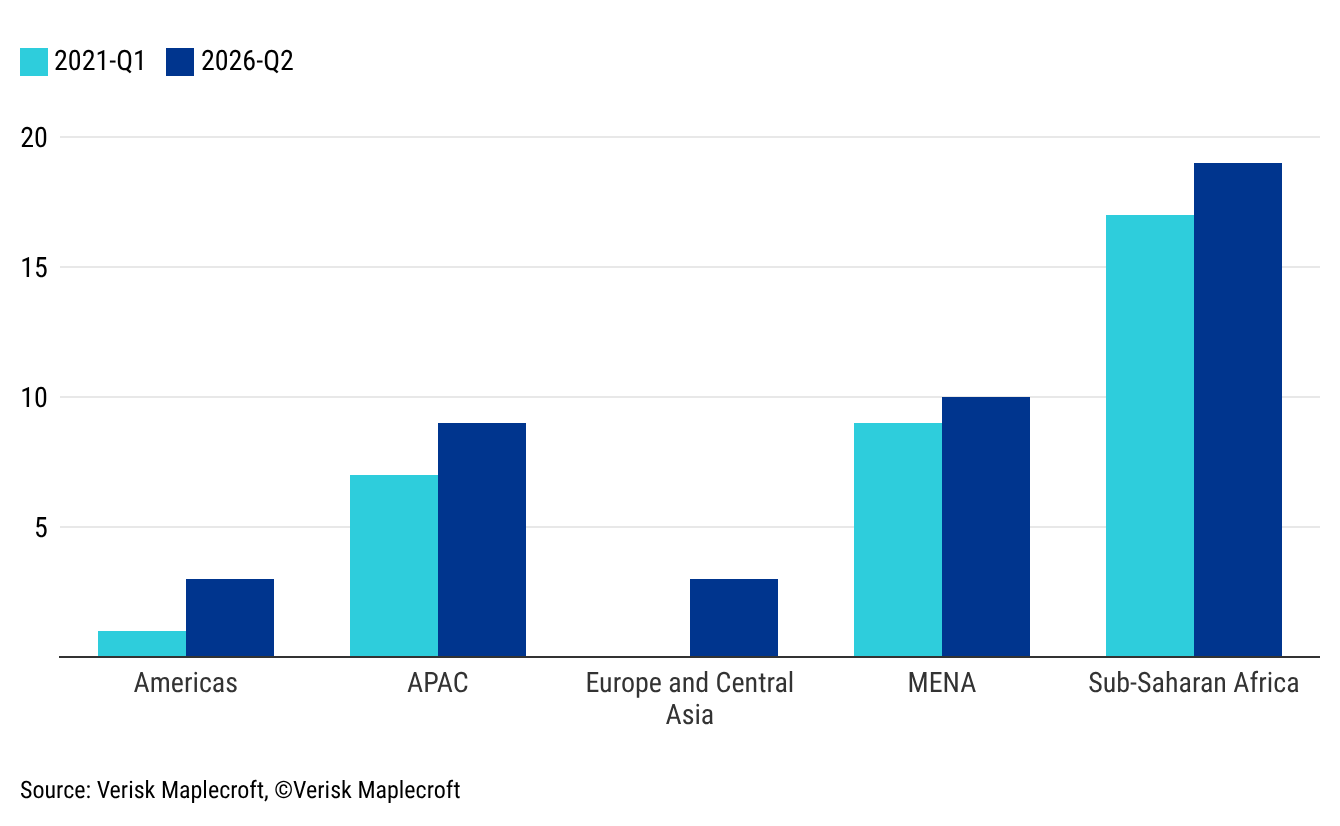
Under our methodology – which aggregates risk across our CAHRA data configuration – 44 countries fall within the high or very high-risk categories and are therefore considered CAHRA. This represents an increase from 34 countries in 2021, with the number of jurisdictions designated as CAHRA rising in all regions (see figure 2).
The highest risk countries within this cohort are primarily frontier jurisdictions that are well known to be risky from a conflict perspective, such as DR Congo and Myanmar. However, the list also includes several major emerging markets that are playing an increasingly important role in the global economy, including India and Indonesia.
Importantly, our analysis shows that CAHRA cannot be identified by assessing armed conflict in isolation. Eleven of the 44 countries designated as CAHRA under our configuration – including Bangladesh and Kenya – are not currently assessed as being “in conflict” within our Conflict Intensity Index. Instead, their scores are negatively impacted by other risk factors, such as conflict in neighbouring countries, domestic political instability, institutional weakness or widespread breaches of human rights.
This reinforces the need for organisations to pair credible conflict data with broader country risk metrics when monitoring their CAHRA risk exposure. Our data delivers the breadth and dynamism needed to proactively track the full spectrum of risks shaping a country’s overall risk profile, including governance and social risks that are often less immediately visible than conflict.
Our quarterly update cycle enables you to recognise and quickly respond to emerging trends. For example, several countries in the Middle East have seen their performance on the CAHRA data configuration deteriorate since hostilities escalated in the region at the end of February. Iran was already designated as a CAHRA prior to the latest data update, but its score has now worsened significantly, leaving the country ranked 13th highest risk in the dataset. Israel, Lebanon and the Occupied Palestinian Territories are also currently designated as CAHRA.
Elsewhere, Jordan has seen a marked deterioration on our conflict pillar. Combined with its poor performance on several of our human rights indices, the country now sits just outside of our high risk category. Movements of this nature can serve as an early signal for enhanced due diligence for organisations sourcing from, selling to, or investing in countries where CAHRA-related risks are intensifying.
To continue reading, download our How to guide below.