Key Takeaways
- New forced labour import bans can disrupt supply chains overnight and without warning, even where actual supplier‑level forced labour risk is low
- Procurement teams must now consider forced labour as a trade and geopolitical risk, not only as a responsible business and compliance matter
- Businesses should prioritise critical inputs, map country-level sourcing and enforcement risk, and build scenario-led response capabilities before goods are detained at the border
Forced labour laws are rapidly becoming a source of geopolitical risk across global supply chains in 2026. Regimes such as the UFLPA in the US, Canada's forced labour prohibition, and the forthcoming EU Forced Labour Regulation, are increasingly operating as de facto trade controls across borders, empowering authorities to detain shipments immediately, with no grace period or warning.
The blind spot for many companies is that enforcement risk does not map cleanly to supplier-level labour risk. Even businesses with limited direct exposure can face sudden disruption if regulators target a product, a country, or an upstream link in the supply chain.
This risk may also be underestimated, as many companies assume ESG pressures are receding. In practice, forced labour is becoming more of a priority in comparison to the broader ESG agenda, as it is increasingly enforced through trade policy as a geopolitical tool.
The scale of disruption is already significant
The new enforcement regimes are already having a material impact on supply chains. Between June 2022 and February 2026, U.S. Customs and Border Protection detained nearly 42,000 shipments under UFLPA — worth $3.94 billion USD — denying entry to more than 22,000 consignments across multiple sectors. The scope of enforcement has also been broad, with U.S. authorities detaining goods from over 11 industries and 16 countries for forced labour concerns. However, these detentions only capture a fraction of the risk. However, these detentions only capture a fraction of the risk.
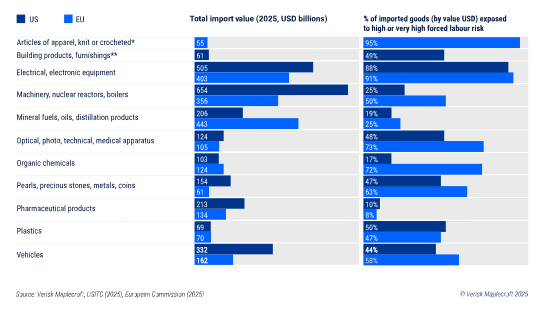
Figure 1 illustrates how forced labour risk permeates the supply chains of the EU’s and the US’s largest import categories. Across goods imported into the EU, an estimated $903 billion USD exposed to high or very high forced labour risk, including 95% ($44.7 billion USD) of apparel imports.1 . While imports into the US carry a relatively lower level of forced labour risk than those entering the EU, the exposure is still substantial, with over $1 trillion USD of imports facing high or very high risk.
Enforcement is increasingly driven by geopolitics
Forced labour enforcement is undoubtedly rising globally, but not in a predictable way. While regimes remain grounded in labour conditions, it is geopolitical and trade dynamics that are increasingly shaping where those rules are applied.
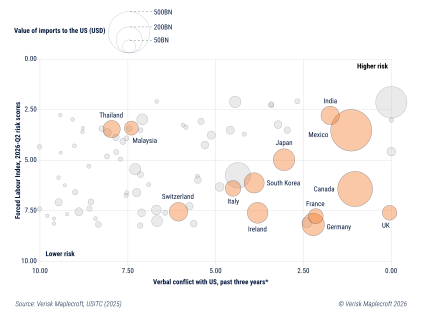
A clear example of this shift came from the US in early 2026. Following the Supreme Court’s decision to strike down sweeping tariffs, the US government launched investigations into 85 countries, including the EU, UK and Canada, to assess whether they have failed to implement or effectively enforce bans on imports linked to forced labour.
These investigations, conducted under the US Trade Act of 1974, established a basis for imposing tiered, double-digit tariffs on imports from countries judged to have inadequate forced labour regimes, even in locations which, according to our data, have low levels of risk.
This marks an important shift, because many of these jurisdictions would not typically be prioritised in supplier due diligence. It means enforcement is expanding from risk within supply chains, towards broader country-level considerations shaped by trade objectives and political relationships. This raises a practical question for companies: where will enforcement be influenced by geopolitics, not just forced labour risk?
What does this mean for corporate supply chains?
Procurement teams should begin treating forced labour as a geopolitical trade risk, not just a legal and ethical obligation, as part of a full-spectrum approach to risk management. The question is no longer only "Where do we have forced labour risk?", but "Which enforcement event is most likely, what are the impacts, and how quickly could we respond?"
Procurement teams should also identify their most critical exposures and evaluate the top inputs where disruption would have the greatest operational impact, considering dependency, substitutability and import exposure risk. Comprehensive exposure mapping also reveals where country-level sourcing exposure, forced labour risk and enforcement likelihood combine to create the highest disruption potential across the supplier base.
Crucially, traceability should be prioritised where it matters most – by extending visibility beyond Tier 1 into upstream inputs and by focusing on areas where risk and criticality intersect.