Key Takeaways
- The number of countries rated high or very high risk on our Conflict Intensity Index has risen by 40% since 2021, increasing the risk of disruption across global supply chains
- Conflict-affected and high-risk areas are creating deeper human-rights exposure, particularly in countries and sectors where visibility beyond Tier 1 remains limited
- Companies need to integrate conflict, governance and human-rights risk data into sourcing decisions to anticipate disruption, regulatory, and reputational risks
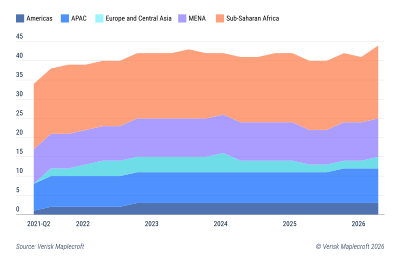
Conflict leads the global agenda in 2026, but businesses are still underestimating the risks these conflicts create deep within supply chains. The number of countries classified as high or very high risk within our Conflict Intensity Index has risen 40% in just five years, from 30 in 2021- Q2 to 42 in 2026-Q2.
For many businesses, the immediate focus has been on direct threats to personnel, assets and supply routes. But secondary impacts are becoming increasingly significant. As the rule of law deteriorates in conflict-affected regions, the likelihood of human rights breaches rises, at precisely the moment regulatory expectations are tightening.
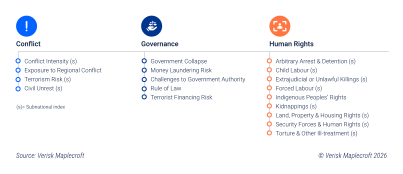
Central to this is the concept of conflict-affected and high-risk areas (CAHRAs), which underpins a growing set of regulatory requirements around how companies assess conflict-related human rights risks. Our CAHRA data – covering 18 conflict, security, governance and human rights risks across 198 countries – now identifies elevated risk in 44 countries, up from 34 in 2021.
Significantly, 11 of these are not currently assessed as being “in conflict” by our data. The CAHRA designation also applies to non-conflict zones that have "high-risk" vulnerabilities, including conflict in neighbouring countries, refugee flows and domestic instability – underscoring the need for organisations to take a broader view of risk.
Conflict and security-related human rights pressures rising in key sourcing locations
In conflict-affected environments, risks often emerge earlier than traditional models detect – through deteriorating workforce conditions, community relations, and local security – long before disruption appears in shipping or output data.
As a result, most risk dashboards miss the early warning signals that precede production shutdowns or the gradual erosion of labour standards. Closing these blind spots requires a fundamental shift in how companies identify and respond to risk. To define CAHRAs, we assess governance, human rights and conflict – but it’s human rights that is driving the highest risks.
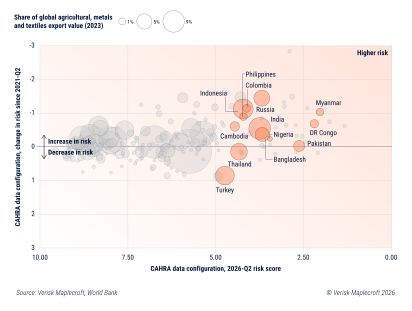
This is the case in countries such as Bangladesh, India and Indonesia, which are central to supply chains across apparel, agriculture, and natural resources. Thailand, which experienced border clashes with Cambodia last year, has seen a marginal improvement, alongside Turkey, where exposure across textiles and manufacturing is a key concern for supply chains, but our data shows that human rights challenges remain elevated in both.
These risks can translate directly into operational disruption. Curfews and domestic insecurity affect workforce availability, as detention, migration and displacement reduce access to skilled labour. Land disputes block facilities access; and security incidents interrupt logistics. These dynamics are often invisible in standard supply chain due diligence processes, particularly beyond Tier 1 where subcontracting and informal labour are prevalent.
Many companies rely on single metrics that assume country-level stability, meaning human rights exposure is only discovered once it’s already become a crisis. This gap is becoming more consequential as frameworks such as the EU’s Corporate Sustainability Due Diligence Directive (CSDDD) place greater responsibility on companies to identify and address risks deep within value chains.
Human rights deterioration is driving overall risk exposure
Our data shows that high-risk environments are characterised by deteriorating rule of law, higher levels of corruption and widening governance gaps. State security forces are often unable or unwilling to protect citizens – and in some cases become directly implicated in severe breaches of human security. Reports from human rights groups and the media highlight the prosecution of opposition voices in Cambodia and Thailand, and the targeting of activists in Indonesia.
Indigenous peoples’ rights are also under increasing pressure, particularly in resource-rich regions, with some states using detention and force against communities opposing mining and infrastructure projects. For example, the Philippines now ranks as very high risk on our Indigenous Peoples’ Rights Index, following arrests of demonstrators protesting mining on ancestral lands in Nueva Vizcaya in early 2026.
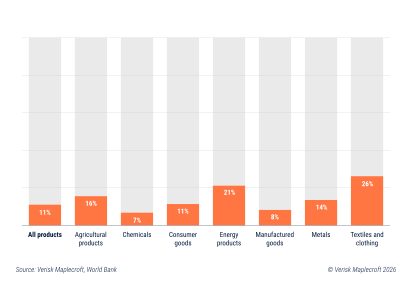
These country-level dynamics are driving a structural shift in global supply chain exposure. An increasing share of economic value is now concentrated in CAHRAs, particularly in upstream and resource-intensive sectors.
Over 21% of global oil and gas export value flows from CAHRAs – exposure that cascades into downstream industries including automotive, chemicals and aviation. Agricultural goods and metals show similar patterns at 16% and 14% respectively. Textiles remains the most exposed sector, with more than a quarter of global value tied to high-risk geographies.
Taken together, this suggests that CAHRA exposure is not only deepening within specific sectors but broadening across the global economy.
Human rights conditions signal continuity risk earlier than traditional metrics
Limited visibility beyond Tier 1 significantly increases the risk of indirect association with breaches of human rights, conflict financing, or governance failures at a time when regulatory scrutiny and investor expectations are intensifying. Businesses must shift from reactive compliance to proactive risk management: making sourcing decisions before risks escalate, prioritising contract management in high-risk locations, stress-testing supply strategies, and strengthening grievance mechanisms while alternatives remain available.
Better data is now critical. Companies need location- and sector-specific risk signals that connect conflict, security, governance and human rights issues to real supply chain exposure. This will allow them to distinguish urgent risks from emerging ones, focus resources where they matter most, and act before disruption, cost escalation or reputational damage has already occurred.